
Most professionals have encountered a leader who had every credential on paper but struggled when circumstances changed. They may also have worked with someone who had less experience but learned and adapted faster than expected. That difference usually comes down to one trait: learning agility.
Organizations are starting to notice. They're no longer just asking, “What has this person done before?” They're asking, “How quickly can this person learn what they don't know yet?” That shift is reshaping how companies hire, promote, and develop leaders.
What Is Learning Agility in Leadership?
Learning agility is the ability and willingness to learn from experience and apply those lessons to new situations.
For leaders, that means more than attending training or gaining new knowledge. A learning-agile leader reflects on experience, seeks feedback, questions assumptions, experiments with different approaches, and changes direction when evidence suggests a better path.
The Center for Creative Leadership describes learning agility as the willingness and ability to learn from experience and apply that learning to new situations. Its research also identifies learning agility as an important component of leadership potential.
This distinction matters. A leader may have years of experience, but continue repeating the same approach. Another leader may have less experience but learns quickly from every project, conversation, success, and setback.
The second leader is demonstrating greater learning agility.
In practice, learning agility can help leaders:
- Remain effective when priorities change
- Learn from both success and failure
- Ask better questions before making decisions
- Seek perspectives that challenge their assumptions
- Adjust their leadership approach to different people and situations
- Apply lessons from one challenge to another
- Stay curious when familiar solutions no longer work
Learning agility is not about constantly changing direction. It is about learning quickly enough to recognize when change is necessary.
Why Is Learning Agility Important in Leadership?
Learning agility is important in leadership because leaders are regularly expected to make decisions in situations where experience offers only part of the answer.
A new manager may inherit a team with challenges they have never handled before. A senior executive may need to guide an AI initiative without years of direct AI experience. A department leader may suddenly face a major shift in customer demand.
In each case, leadership effectiveness depends on the ability to learn while leading.
Research has long connected learning agility with leadership potential and performance. Korn Ferry has reported, based on thousands of senior executive assessments, that learning agility is a strong predictor of executive success. The same research commentary noted that only about 15% of people were considered highly learning-agile.
The need for adaptability is becoming more urgent. According to the World Economic Forum’s Future of Jobs Report 2025, 39% of workers’ existing skill sets are expected to be transformed or become outdated between 2025 and 2030.
1. Helps Leaders Navigate Uncertainty
Learning-agile leaders stay open to new information and different perspectives. This helps them make informed decisions while adjusting as conditions change.
2. Improves Decision-Making
Learning agility helps leaders question assumptions, consider new evidence, and avoid relying only on solutions that worked in the past.
3. Makes Change Easier to Lead
Agile leaders approach change with curiosity and help teams understand, accept, and adapt to new ways of working.
4. Supports Innovation
Leaders learn from experiments and setbacks, creating space for new ideas while maintaining accountability.
5. Strengthens Leadership Pipelines
Learning agility helps organizations identify and develop leaders who can grow into unfamiliar roles and take on greater responsibilities.
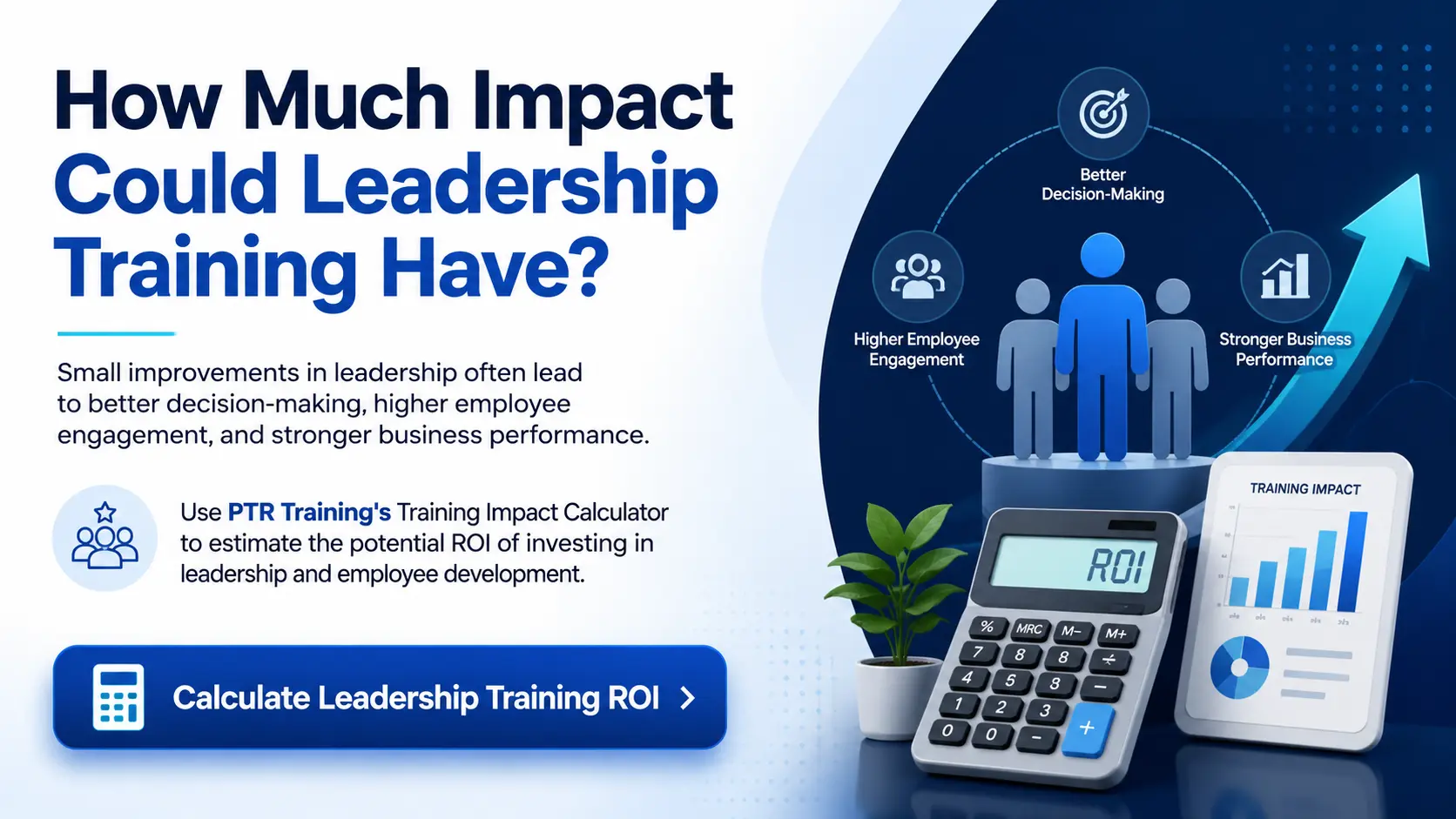
Organizations preparing managers for larger responsibilities should evaluate how leadership development can strengthen adaptability, decision-making, communication, and confidence before the next major transition.
Why Experience Alone Is No Longer Enough for Leadership Success
Experience remains valuable, but past success does not always prepare a leader for the next challenge. Business priorities change, technologies evolve, and leaders are increasingly expected to make decisions in situations they have never encountered before.
This means organizations should look beyond what a leader already knows and consider how effectively they learn. Leaders who reflect on experience, seek feedback, question assumptions, and apply lessons in new situations are better equipped to handle unfamiliar challenges.
Leadership development should therefore do more than prepare people for known responsibilities. It should build confidence and capability to learn while leading. Organizations that develop this ability can create a stronger leadership pipeline that is better prepared for change, uncertainty, and future business needs.
The Five Dimensions of Learning Agility
A widely used view of learning agility examines several dimensions of how people think, respond to change, work with others, and pursue results. Different models use slightly different terminology, but the following five areas provide a practical framework.
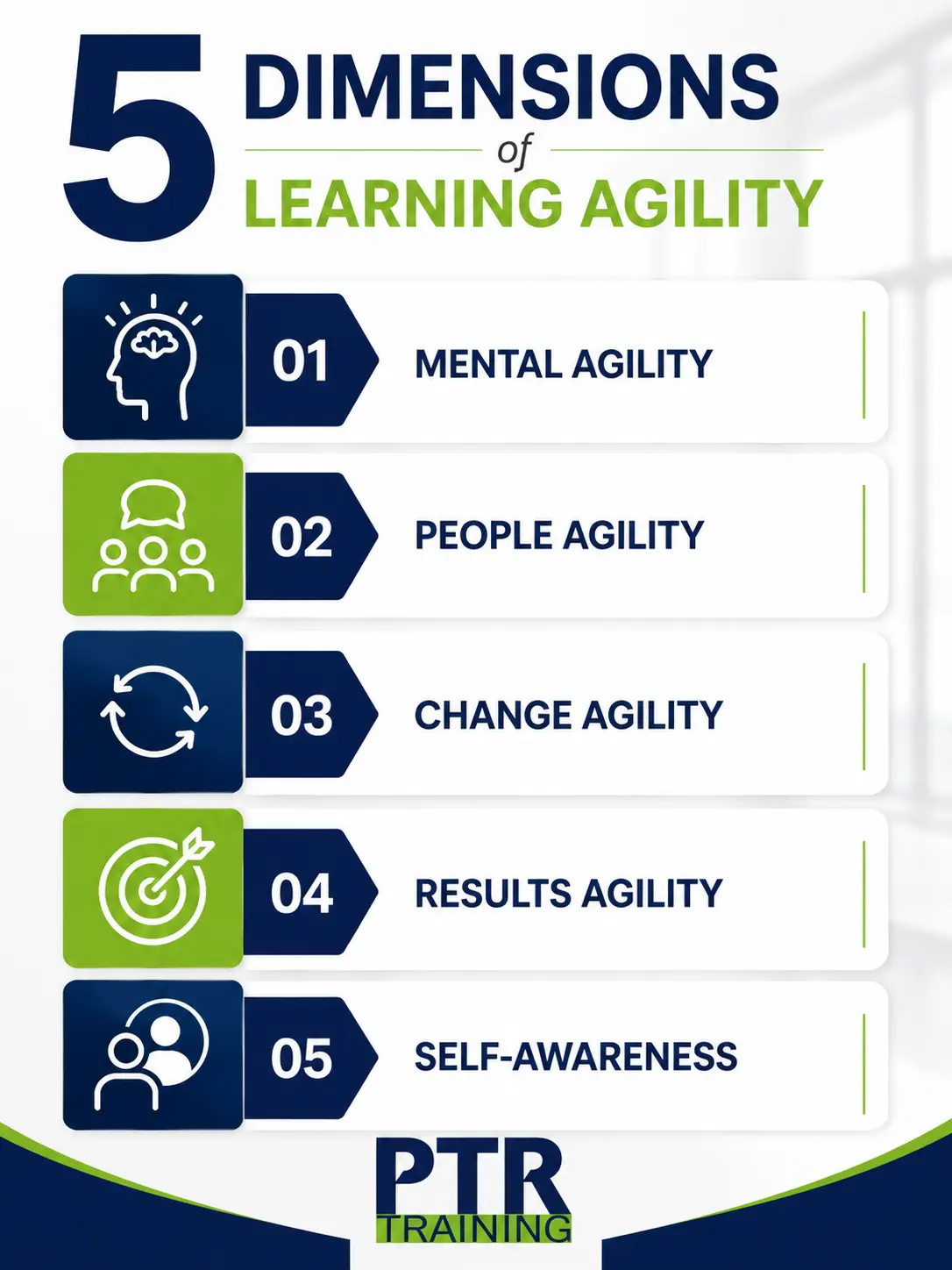
1. Mental Agility
Mental agility is the ability to examine problems from different angles.
A mentally agile leader does not immediately settle for the most familiar answer. Instead, they ask questions, look for patterns, and consider alternative explanations.
This is especially useful when problems are complex, and the first explanation may be incomplete.
2. People Agility
Leadership happens through people. People agility involves learning from others and adjusting how you communicate, coach, and collaborate.
A people-agile leader can work effectively with different personalities, functions, generations, and perspectives. They listen carefully and recognize that a preferred communication style may not work for everyone.
3. Change Agility
Change-agile leaders are curious about new possibilities. They are willing to experiment and explore better ways of working.
This does not mean adopting every trend. It means staying open enough to test useful ideas rather than rejecting them because they are unfamiliar.
4. Results Agility
Results agility is the ability to deliver under new or challenging conditions.
When a familiar plan no longer works, a results-agile leader does not simply push harder on the same approach. Instead, they identify what needs to change and keep the team focused on the desired outcome.
5. Self-Awareness
Learning begins with an accurate understanding of one's own strengths, limitations, habits, and impact.
Self-aware leaders are more likely to recognize when their assumptions may be incomplete. They can receive useful feedback without immediately becoming defensive.
Without self-awareness, experience can reinforce poor habits. With reflection, experience becomes a source of development.
How to Develop Learning Agility in Leaders
Learning agility can be developed through consistent practice and real-world experience. Leaders improve when they reflect on challenges, seek different perspectives, and apply what they learn to future situations.
1. Take on Stretch Assignments
New responsibilities expose leaders to unfamiliar problems and encourage different ways of thinking. Leading a cross-functional project or managing a change initiative can build confidence in uncertain situations.
The key is reflection. After completing a challenging assignment, leaders should consider what worked, what did not, and what lessons can be applied elsewhere.
2. Build a Feedback Habit
Regular feedback helps leaders recognize blind spots and understand how their actions affect others. Feedback is most useful when it is specific, timely, and focused on behaviors that can be changed.
Leaders should seek perspectives from colleagues, managers, and team members rather than relying only on familiar viewpoints.
3. Reflect on Experience
Experience creates learning only when leaders take time to examine it. After an important project or decision, review what happened, why it happened, and what should change next time.
Short after-action reviews can help teams turn individual experiences into shared knowledge.
4. Apply Learning to Real Work
Training creates greater value when leaders use new skills immediately. After learning a new concept, leaders should identify an upcoming meeting, decision, or conversation where they can practice it.
This connection between learning and application helps turn knowledge into lasting leadership behavior.
5. Strengthen Self-Awareness
Self-awareness helps leaders understand their habits, strengths, blind spots, and reactions under pressure. Feedback, coaching, assessments, and regular reflection can provide useful insights.
When leaders understand their own patterns, they can make more intentional choices and adapt their approach to different people and situations.
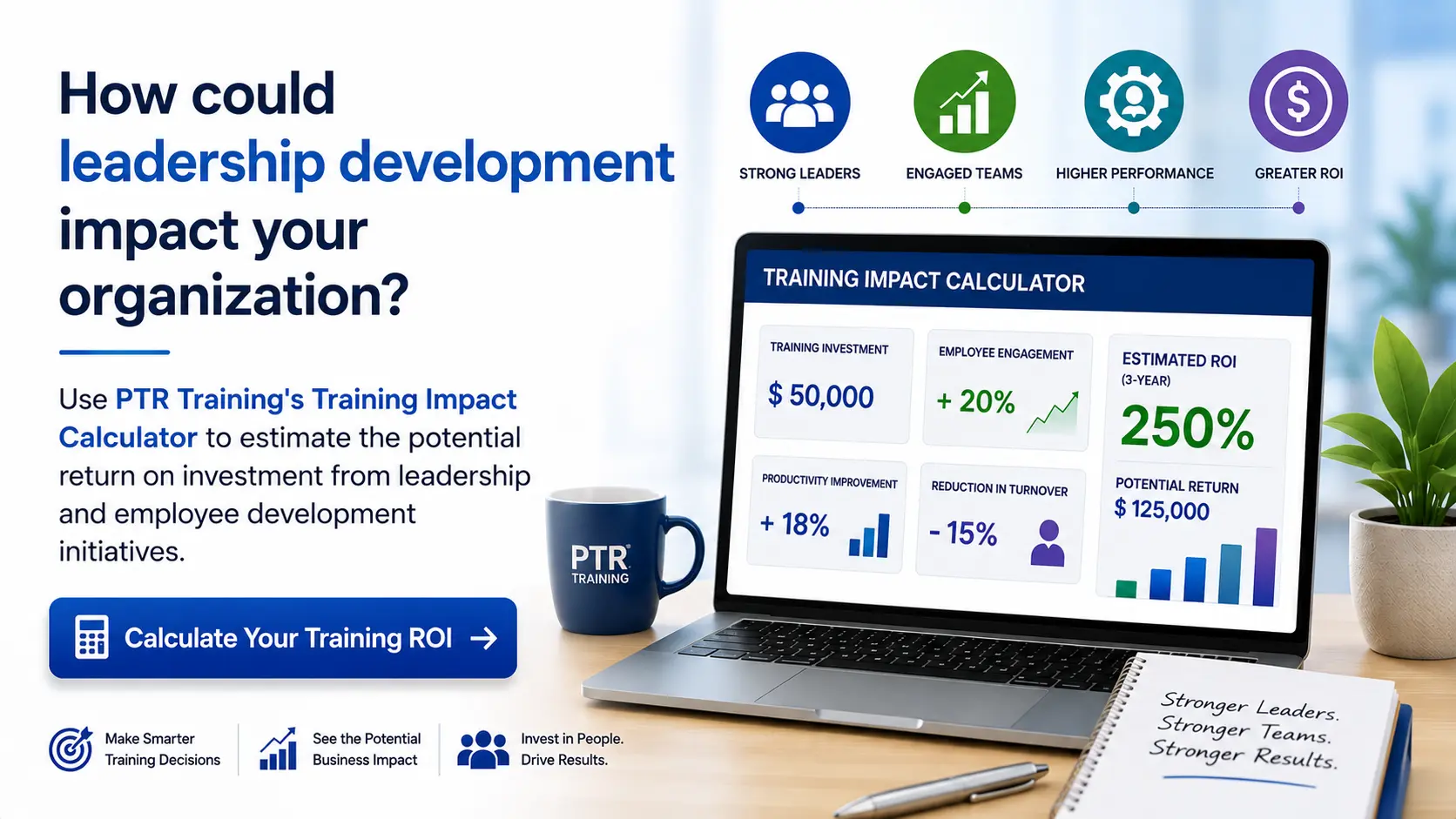
Organizations can strengthen these capabilities through structured leadership development initiatives that help leaders improve communication, decision-making, problem-solving, and performance in complex workplace situations.
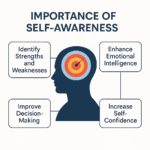
Have you Read? Importance of Self Awareness in Leadership Development
How PTR Training Helps Build Learning-Agile Leaders
Developing learning agility requires more than one-time workshops. It requires practical learning experiences that enable leaders to apply new skills in real workplace situations. At PTR Training, our leadership development training programs combine interactive training, coaching, real-world scenarios, and actionable strategies to strengthen adaptability, decision-making, communication, and problem-solving.
Every training program is tailored to your organization's unique goals, helping leaders build the confidence to navigate change, inspire their teams, and drive stronger business performance. Whether you're developing new managers or experienced leaders, PTR Training delivers practical solutions that foster measurable leadership growth and long-term organizational success.
Ready to Build Learning-Agile Leaders?
Help your leaders adapt faster, make smarter decisions, and confidently navigate change. PTR Training's Learning Agility Training equips managers and leaders with practical, real-world skills they can apply immediately to improve individual performance, strengthen team effectiveness, and drive long-term organizational success.
A Practical Learning Agility Development Cycle
Learning agility develops when leaders have opportunities to learn, apply new skills, and reflect on the results. Organizations can support this process through a simple development cycle:
Leaders begin with real-world experience, such as managing a difficult conversation, leading a new project, or responding to change. They then reflect on what happened, seek feedback from others, and identify lessons to apply to the next situation.
The final step is reviewing the outcome and adjust your approach where necessary. Repeating this cycle helps leaders turn everyday workplace experiences into continuous development opportunities.
Leadership training can support this process by combining structured learning with practical application, feedback, coaching, and reflection. This helps leaders move beyond simply understanding new concepts and begin applying them effectively in real workplace situations.
Expert Insight from PTR Training
At PTR Training, we've observed that learning agility becomes most visible when leaders face situations they haven't encountered before. The leaders who succeed aren't always the most experienced—they're the ones who remain curious, ask thoughtful questions, seek feedback, and adapt their approach without losing focus on business outcomes.
Organizations that intentionally develop learning agility through coaching, stretch assignments, and practical leadership development programs are often better prepared to navigate change and build stronger leadership pipelines.
Frequently Asked Questions
What is learning agility?
Learning agility is the ability to learn from experience and apply those lessons to new or unfamiliar situations. It involves staying curious, seeking feedback, reflecting on successes and setbacks, and adjusting your approach when circumstances change. In leadership, learning agility helps leaders make better decisions, solve new problems, and remain effective in changing workplace environments.
What are the benefits of learning agility training for leaders?
Agility training helps leaders and employees become more adaptable, confident, and effective when facing change. It can improve decision-making, problem-solving, self-awareness, communication, and the ability to learn from experience. For organizations, agility training can also support stronger leadership pipelines, improve change readiness, encourage innovation, and help teams respond more effectively to evolving business needs.
Why is learning agility important for leaders?
Learning agility helps leaders make decisions in unfamiliar situations, respond constructively to change, and learn from both successes and setbacks. It also helps leaders model curiosity and continuous improvement, which can influence how their teams approach feedback, experimentation, and workplace change.
Is learning agility the same as intelligence?
No. Intelligence generally refers to the ability to process information, reason, and solve problems. Learning agility focuses on how effectively a person learns from experience and applies those lessons to new or unfamiliar situations. A person can be highly intelligent while still demonstrating low learning agility.
How is learning agility different from workplace agility?
Learning agility is a personal trait focused on how someone learns from experience. Workplace agility is broader and includes how an entire team or organization adapts to change, processes, and structure.
Final Thoughts
Learning agility is becoming increasingly important as leaders face unfamiliar challenges, changing technologies, and evolving workforce expectations. Leaders who learn from experience, seek feedback, and adapt their approach are better prepared to make decisions and maintain performance in changing conditions.
For organizations building a leadership pipeline, experience should not be the only consideration. Look at how fast people learn, how they respond to feedback, and how effectively they apply lessons in new situations.