

10 Persuasive Presentation Tips for Business Professionals

Persuasive Presentation Tips for Business Professionals

A business presentation is not successful simply because you delivered all the information on your slides. The real measure of success is what your audience does after you finish speaking. Do they approve the proposal, support the strategy, fund the project, or take the next step?

That is what makes persuasive presentations different from ordinary presentations. You are not only sharing information. You are helping people understand why an idea matters and giving them a reason to act.

For business professionals, this skill matters across sales meetings, executive briefings, project proposals, team meetings, client presentations, and leadership conversations. The World Economic Forum's Future of Jobs Report 2025 identifies leadership and social influence as one of the most important core skills employers seek, with 61% of surveyed employers considering it essential.

The good news is that persuasion is not something you either have or do not have. You can develop it through better preparation, audience awareness, clear messaging, storytelling, confident delivery, and deliberate practice.

What Is a Persuasive Presentation?

A persuasive presentation is designed to influence how an audience thinks, feels, or acts.

You might use one to convince executives to approve a new initiative. You might use another to persuade a client to choose your solution. You could also use one to gain support for a process change or motivate your team around a new direction.

Unlike an informational presentation, a persuasive presentation requires a clear outcome.

Before you begin, ask yourself:

What do I want my audience to believe, decide, or do after this presentation?

That answer should guide your message, examples, visuals, evidence, and conclusion.

Why Persuasive Presentations Matter at Work

Professionals are constantly asked to influence others.

You may need approval for a budget approval, explain a business case, recommend a solution, present performance results, or persuade a customer to move forward.

Presentation skills are therefore closely connected to leadership and communication.

The need is becoming even more important as workplaces change. The World Economic Forum reports that employers expect 39% of workers' existing skill sets to be transformed or become outdated between 2025 and 2030. Leadership and social influence, creative thinking, analytical thinking, and adaptability are among the skills employers continue to value.

Presentation skills can help you turn those capabilities into visible workplace impact.

A strong presentation allows you to:

  • Explain complex ideas clearly
  • Build credibility with decision-makers
  • Gain support for recommendations
  • Handle questions and objections
  • Demonstrate leadership
  • Influence stakeholders
  • Motivate teams to take action
  • Communicate change more effectively

The lesson is simple: presenting is not just a speaking exercise. It is a business skill.

Explore how PTR Training's Advanced Public Speaking & Presentation Skills Course can help your team build this process from the ground up.

10 Tips to Make Your Business Presentations More Persuasive
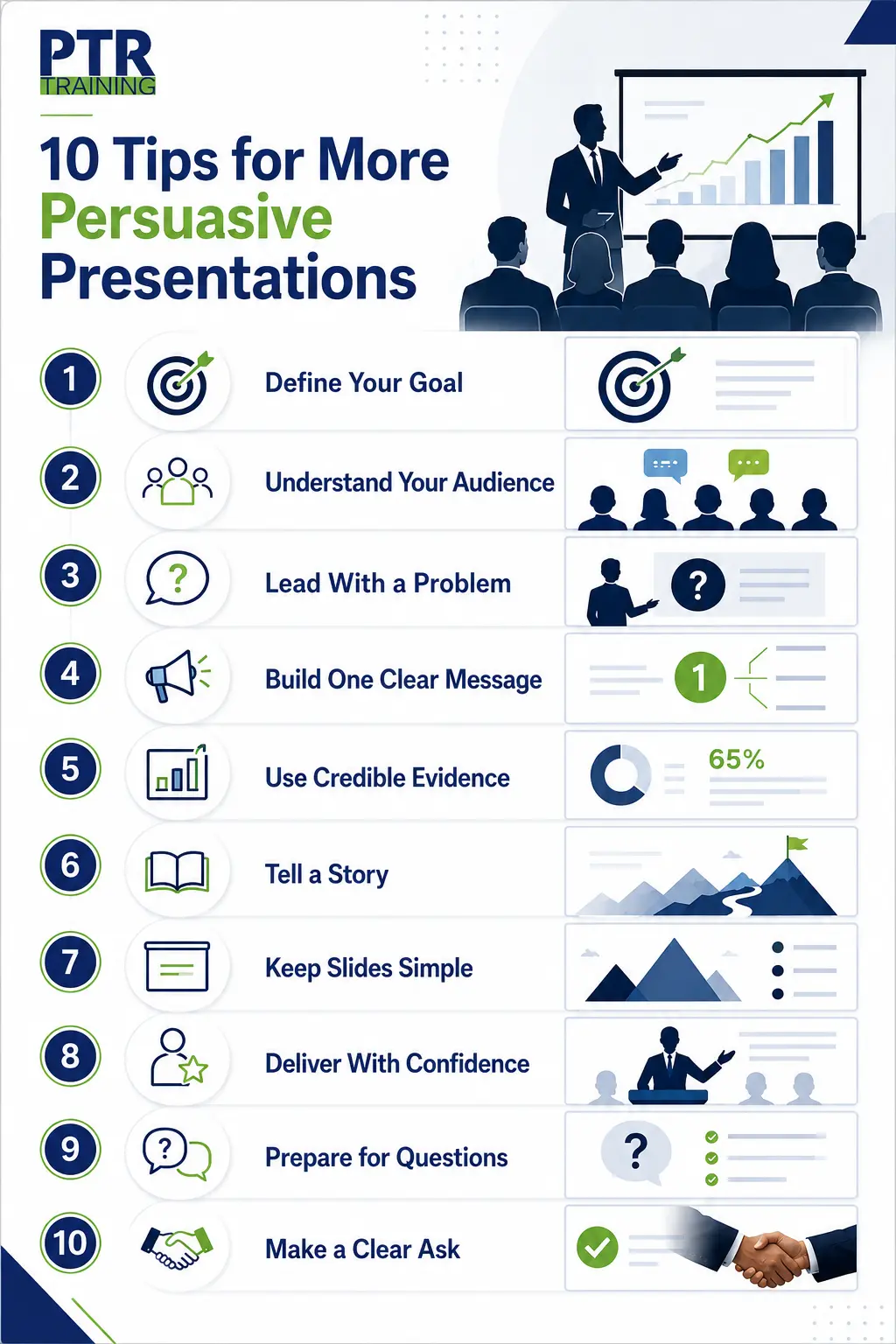
10 Tips to Make Your Business Presentations More Persuasive

1. Define Your Presentation Goal

Before creating your slides, decide exactly what you want your audience to think, approve, or do. Your goal might be to secure project approval, gain budget support, win a client, or encourage your team to adopt a new process.

Keep the outcome specific. When you know what success looks like, you can build your message, evidence, examples, and call to action around that objective.

A clear goal also helps you remove information that does not support your main point.

2. Understand Your Audience

Effective persuasion starts with understanding the people you are presenting to. Consider their responsibilities, priorities, knowledge level, concerns, and decision-making authority.

A finance leader may focus on cost and return, while a department manager may care more about implementation and team impact.

Think about the questions your audience may ask before you begin. The more relevant your presentation feels to their needs, the easier it becomes for them to connect with your recommendation.

3. Lead With a Problem That Matters

Start by showing your audience why the topic deserves their attention. Instead of immediately introducing your solution, explain the business problem or opportunity first.

Highlight its impact with a relevant example, statistic, or business outcome. When people understand the cost of inaction, they have a stronger reason to consider your recommendation.

A simple structure works well: identify the problem, explain its impact, introduce your solution, and show the benefit.

4. Build One Clear Central Message

Your presentation should have one main idea that your audience can remember after you finish speaking. Avoid trying to communicate several unrelated messages at once.

Identify your central message and make each supporting point reinforce it. For example, if you recommend automating reporting, your key points should explain the expected time savings, accuracy, business value, or implementation benefits.

Review every slide and ask whether it supports your main argument. If it does not, consider removing it or moving it to supporting material.

5. Support Your Argument With Credible Evidence

Persuasive presentations become stronger when your recommendations are supported by reliable evidence. Use relevant statistics, research, customer data, case studies, financial information, or industry findings.

Avoid adding numbers simply to make your presentation appear more authoritative. Every statistic should have a purpose and help your audience understand the situation or potential outcome.

When using external research, verify the original source and explain why the finding matters. A few strong pieces of evidence can be more convincing than a collection of unrelated facts.

6. Use Stories to Make Your Message Memorable

Business presentations do not have to rely entirely on charts and statistics. A short, relevant story can help your audience understand the real-world impact of your message.

You might describe a customer challenge, employee experience, project problem, or result achieved after implementing a solution. Keep the story focused and connect it directly to your main argument.

A simple structure is situation, challenge, action, and result. Stories work particularly well when you need to make an abstract business issue easier to understand.

7. Keep Your Slides Simple and Purposeful

Your presentation slides should support what you are saying rather than compete with you for attention. Avoid filling slides with long paragraphs, excessive bullet points, or unnecessary graphics.

Instead, use concise headlines, meaningful visuals, charts, comparisons, and key numbers. Your slide title can communicate the main takeaway instead of simply describing the content.

For example, “Customer Satisfaction Improved 18%” is more informative than “Customer Satisfaction Results.” Your audience immediately understands why the information matters.

8. Deliver Your Message With Confidence

Your delivery can influence how your audience perceives your credibility. Speak clearly, maintain comfortable eye contact, use natural gestures, and avoid rushing through important points.

Purposeful pauses can give your audience time to process an important idea. Varying your pace and vocal emphasis can also prevent your delivery from sounding flat or rehearsed.

You do not need to sound like a professional performer. Practice aloud before the presentation to become comfortable with your message while keeping your delivery natural.

9. Prepare for Questions and Objections

Questions are a normal part of persuasive presentations, especially when your audience is considering an important business decision. Think about the strongest objections they may have and prepare concise responses in advance.

Consider questions about cost, risk, timing, resources, alternatives, implementation, and expected results.

During the presentation, listen carefully before responding and avoid becoming defensive when someone challenges your recommendation. A thoughtful response can strengthen your credibility and show that you have considered different perspectives.

10. Close With a Specific, Actionable Ask

A persuasive presentation should give your audience a clear understanding of what happens next. Do not end with a vague “Thank you” and leave your audience guessing about your desired outcome.

Instead, make your requested action specific. You might ask for approval, schedule a follow-up meeting, authorize a pilot project, or recommend a new process.

Connect your request to the benefits you established throughout the presentation. A strong call to action turns an informative presentation into a conversation that can lead to a meaningful business decision.

What Could Better Presentation Skills Mean for Your Organization?

Investing in presentation training can help professionals communicate recommendations more clearly, influence stakeholders, handle important business conversations, and turn ideas into action. The potential impact can extend beyond individual presenters to team productivity, communication effectiveness, and business outcomes.

Want to estimate the potential return of your training investment?

Use PTR Training's Training Impact Calculator to explore the potential ROI of investing in employee and leadership development.

Calculate Training ROI
Training Impact Calculator

How Can You Make a Presentation More Persuasive?

Make your presentation more persuasive by focusing on the audience's needs before your own talking points. Start with a clear problem, explain why it matters, present evidence, connect the solution to a meaningful benefit, and finish with a specific action.

Your delivery also matters. Use confident body language, natural pacing, purposeful pauses, and direct eye contact. Most importantly, avoid trying to say everything. A focused argument is usually easier to understand and remember than an overloaded presentation.

How Important Is Practice for Persuasive Presentations?

Practice is essential because it helps you become familiar with your message without making your delivery sound memorized.

Practice your opening, transitions, key statistics, examples, conclusion, and likely questions.

Do at least one full rehearsal out loud.

If possible, record yourself or practice in front of a colleague. Look for areas where you speak too quickly, repeat phrases, lose your place, or spend too much time explaining minor details.

PTR's presentation programs emphasize practical preparation, delivery, storytelling, audience engagement, and feedback to develop stronger presentation skills.

Also read: How to Improve Customer Service That Drives Business Revenue

How PTR Training Helps Professionals Deliver More Persuasive Presentations

Knowing persuasive presentation techniques is only the first step. Professionals also need opportunities to practice those techniques, receive feedback, and apply them to realistic business situations. PTR Training's presentation skills training helps professionals strengthen the skills needed to plan, structure, and deliver presentations that connect with different audiences.

Training can cover practical areas such as audience analysis, persuasive messaging, storytelling, visual aids, confident delivery, body language, audience engagement, and handling questions or difficult situations. Through interactive exercises and practical scenarios, participants can apply these skills rather than simply learning presentation theory.

The goal is to help professionals communicate complex ideas more clearly, build credibility with decision-makers, handle objections with confidence, and guide audiences toward meaningful business actions. Whether your team presents to clients, executives, colleagues, or stakeholders, stronger presentation skills can make important business conversations more focused and effective.

Ready to Strengthen Your Presentation Skills?

Help your team communicate ideas clearly, present with confidence, and influence audiences more effectively. Explore PTR Training's Successful Presentation Skills Training to develop practical skills in presentation planning, storytelling, visual aids, delivery, audience engagement, Q&A, and motivating audiences to action.

Final Thoughts

Persuasive presentations are an essential business skill because professionals rarely present information simply for the sake of sharing it.

You present because you want something to happen. You want a decision. You want support. You want investment. You want behavior to change. You want people to understand and act.

The best approach is not to overwhelm your audience with more information. Instead, build a clear case around what matters to them.

Know your audience. Define one objective. Lead with the problem. Support your recommendation with credible evidence. Use stories and visuals to make the message easier to understand. Deliver it with confidence. Prepare for questions. Then finish with a clear next step.

For leaders who regularly deliver high-stakes presentations, PTR also offers Advanced Presentation Skills Training for Dynamic Leaders, with practical training in persuasive strategies, slide development, delivery, difficult questions, and presentation practice.

A strong presentation can communicate an idea. A persuasive presentation can move that idea forward.

Frequently Asked Questions

What makes a presentation persuasive?

A persuasive presentation combines a clear goal, credible evidence, and a logical structure that guides your audience toward a decision. It also uses story and emotion, not just data, since audiences remember stories far better than raw statistics.

What are the three types of persuasive appeals in a presentation?

Classical persuasion uses three appeals: ethos (credibility), logos (logic and evidence), and pathos (emotional connection). Effective presentations can combine all three to build trust, support an argument, and create a stronger connection with the audience. 

How can I make my presentation more persuasive without sounding pushy?

Focus on the audience's priorities, not just your own. Address likely objections directly, back claims with credible sources, and close with a clear but reasonable ask rather than pressure tactics.

How do you start a persuasive presentation?

Start with something that immediately matters to your audience. You can use a relevant business problem, surprising statistic, thought-provoking question, short story, or important observation. The opening should establish why the topic deserves attention and create a reason to keep listening. Avoid spending too much time on background information before explaining the main issue or opportunity.

Why are presentation skills important for business professionals?

Presentation skills help professionals communicate ideas, influence decisions, explain complex information, and build credibility with colleagues, clients, and leaders. Strong presentation skills are particularly valuable when you need to gain support for a proposal, explain business results, lead change, or communicate a recommendation. Developing these skills can help you become more confident and effective in important workplace conversations.


You May Also Like

Learning & DevelopmentBusiness SkillsCommunication Skills
Persuasive Presentation Tips for Business Professionals

10 Persuasive Presentation Tips for Business Professionals

Persuasive Presentation Tips for Business Professionals

A business presentation is not successful simply because you delivered all the information on your slides. The real measure of success is what your audience does after you finish speaking. Do they approve the proposal, support the strategy, fund the project, or take the next step?

That is what makes persuasive presentations different from ordinary presentations. You are not only sharing information. You are helping people understand why an idea matters and giving them a reason to act.

For business professionals, this skill matters across sales meetings, executive briefings, project proposals, team meetings, client presentations, and leadership conversations. The World Economic Forum's Future of Jobs Report 2025 identifies leadership and social influence as one of the most important core skills employers seek, with 61% of surveyed employers considering it essential.

The good news is that persuasion is not something you either have or do not have. You can develop it through better preparation, audience awareness, clear messaging, storytelling, confident delivery, and deliberate practice.

What Is a Persuasive Presentation?

A persuasive presentation is designed to influence how an audience thinks, feels, or acts.

You might use one to convince executives to approve a new initiative. You might use another to persuade a client to choose your solution. You could also use one to gain support for a process change or motivate your team around a new direction.

Unlike an informational presentation, a persuasive presentation requires a clear outcome.

Before you begin, ask yourself:

What do I want my audience to believe, decide, or do after this presentation?

That answer should guide your message, examples, visuals, evidence, and conclusion.

Why Persuasive Presentations Matter at Work

Professionals are constantly asked to influence others.

You may need approval for a budget approval, explain a business case, recommend a solution, present performance results, or persuade a customer to move forward.

Presentation skills are therefore closely connected to leadership and communication.

The need is becoming even more important as workplaces change. The World Economic Forum reports that employers expect 39% of workers' existing skill sets to be transformed or become outdated between 2025 and 2030. Leadership and social influence, creative thinking, analytical thinking, and adaptability are among the skills employers continue to value.

Presentation skills can help you turn those capabilities into visible workplace impact.

A strong presentation allows you to:

  • Explain complex ideas clearly
  • Build credibility with decision-makers
  • Gain support for recommendations
  • Handle questions and objections
  • Demonstrate leadership
  • Influence stakeholders
  • Motivate teams to take action
  • Communicate change more effectively

The lesson is simple: presenting is not just a speaking exercise. It is a business skill.

Explore how PTR Training's Advanced Public Speaking & Presentation Skills Course can help your team build this process from the ground up.

10 Tips to Make Your Business Presentations More Persuasive

10 Tips to Make Your Business Presentations More Persuasive

1. Define Your Presentation Goal

Before creating your slides, decide exactly what you want your audience to think, approve, or do. Your goal might be to secure project approval, gain budget support, win a client, or encourage your team to adopt a new process.

Keep the outcome specific. When you know what success looks like, you can build your message, evidence, examples, and call to action around that objective.

A clear goal also helps you remove information that does not support your main point.

2. Understand Your Audience

Effective persuasion starts with understanding the people you are presenting to. Consider their responsibilities, priorities, knowledge level, concerns, and decision-making authority.

A finance leader may focus on cost and return, while a department manager may care more about implementation and team impact.

Think about the questions your audience may ask before you begin. The more relevant your presentation feels to their needs, the easier it becomes for them to connect with your recommendation.

3. Lead With a Problem That Matters

Start by showing your audience why the topic deserves their attention. Instead of immediately introducing your solution, explain the business problem or opportunity first.

Highlight its impact with a relevant example, statistic, or business outcome. When people understand the cost of inaction, they have a stronger reason to consider your recommendation.

A simple structure works well: identify the problem, explain its impact, introduce your solution, and show the benefit.

4. Build One Clear Central Message

Your presentation should have one main idea that your audience can remember after you finish speaking. Avoid trying to communicate several unrelated messages at once.

Identify your central message and make each supporting point reinforce it. For example, if you recommend automating reporting, your key points should explain the expected time savings, accuracy, business value, or implementation benefits.

Review every slide and ask whether it supports your main argument. If it does not, consider removing it or moving it to supporting material.

5. Support Your Argument With Credible Evidence

Persuasive presentations become stronger when your recommendations are supported by reliable evidence. Use relevant statistics, research, customer data, case studies, financial information, or industry findings.

Avoid adding numbers simply to make your presentation appear more authoritative. Every statistic should have a purpose and help your audience understand the situation or potential outcome.

When using external research, verify the original source and explain why the finding matters. A few strong pieces of evidence can be more convincing than a collection of unrelated facts.

6. Use Stories to Make Your Message Memorable

Business presentations do not have to rely entirely on charts and statistics. A short, relevant story can help your audience understand the real-world impact of your message.

You might describe a customer challenge, employee experience, project problem, or result achieved after implementing a solution. Keep the story focused and connect it directly to your main argument.

A simple structure is situation, challenge, action, and result. Stories work particularly well when you need to make an abstract business issue easier to understand.

7. Keep Your Slides Simple and Purposeful

Your presentation slides should support what you are saying rather than compete with you for attention. Avoid filling slides with long paragraphs, excessive bullet points, or unnecessary graphics.

Instead, use concise headlines, meaningful visuals, charts, comparisons, and key numbers. Your slide title can communicate the main takeaway instead of simply describing the content.

For example, “Customer Satisfaction Improved 18%” is more informative than “Customer Satisfaction Results.” Your audience immediately understands why the information matters.

8. Deliver Your Message With Confidence

Your delivery can influence how your audience perceives your credibility. Speak clearly, maintain comfortable eye contact, use natural gestures, and avoid rushing through important points.

Purposeful pauses can give your audience time to process an important idea. Varying your pace and vocal emphasis can also prevent your delivery from sounding flat or rehearsed.

You do not need to sound like a professional performer. Practice aloud before the presentation to become comfortable with your message while keeping your delivery natural.

9. Prepare for Questions and Objections

Questions are a normal part of persuasive presentations, especially when your audience is considering an important business decision. Think about the strongest objections they may have and prepare concise responses in advance.

Consider questions about cost, risk, timing, resources, alternatives, implementation, and expected results.

During the presentation, listen carefully before responding and avoid becoming defensive when someone challenges your recommendation. A thoughtful response can strengthen your credibility and show that you have considered different perspectives.

10. Close With a Specific, Actionable Ask

A persuasive presentation should give your audience a clear understanding of what happens next. Do not end with a vague “Thank you” and leave your audience guessing about your desired outcome.

Instead, make your requested action specific. You might ask for approval, schedule a follow-up meeting, authorize a pilot project, or recommend a new process.

Connect your request to the benefits you established throughout the presentation. A strong call to action turns an informative presentation into a conversation that can lead to a meaningful business decision.

What Could Better Presentation Skills Mean for Your Organization?

Investing in presentation training can help professionals communicate recommendations more clearly, influence stakeholders, handle important business conversations, and turn ideas into action. The potential impact can extend beyond individual presenters to team productivity, communication effectiveness, and business outcomes.

Want to estimate the potential return of your training investment?

Use PTR Training's Training Impact Calculator to explore the potential ROI of investing in employee and leadership development.

Calculate Training ROI
Training Impact Calculator

How Can You Make a Presentation More Persuasive?

Make your presentation more persuasive by focusing on the audience's needs before your own talking points. Start with a clear problem, explain why it matters, present evidence, connect the solution to a meaningful benefit, and finish with a specific action.

Your delivery also matters. Use confident body language, natural pacing, purposeful pauses, and direct eye contact. Most importantly, avoid trying to say everything. A focused argument is usually easier to understand and remember than an overloaded presentation.

How Important Is Practice for Persuasive Presentations?

Practice is essential because it helps you become familiar with your message without making your delivery sound memorized.

Practice your opening, transitions, key statistics, examples, conclusion, and likely questions.

Do at least one full rehearsal out loud.

If possible, record yourself or practice in front of a colleague. Look for areas where you speak too quickly, repeat phrases, lose your place, or spend too much time explaining minor details.

PTR's presentation programs emphasize practical preparation, delivery, storytelling, audience engagement, and feedback to develop stronger presentation skills.

Also read: How to Improve Customer Service That Drives Business Revenue

How PTR Training Helps Professionals Deliver More Persuasive Presentations

Knowing persuasive presentation techniques is only the first step. Professionals also need opportunities to practice those techniques, receive feedback, and apply them to realistic business situations. PTR Training's presentation skills training helps professionals strengthen the skills needed to plan, structure, and deliver presentations that connect with different audiences.

Training can cover practical areas such as audience analysis, persuasive messaging, storytelling, visual aids, confident delivery, body language, audience engagement, and handling questions or difficult situations. Through interactive exercises and practical scenarios, participants can apply these skills rather than simply learning presentation theory.

The goal is to help professionals communicate complex ideas more clearly, build credibility with decision-makers, handle objections with confidence, and guide audiences toward meaningful business actions. Whether your team presents to clients, executives, colleagues, or stakeholders, stronger presentation skills can make important business conversations more focused and effective.

Ready to Strengthen Your Presentation Skills?

Help your team communicate ideas clearly, present with confidence, and influence audiences more effectively. Explore PTR Training's Successful Presentation Skills Training to develop practical skills in presentation planning, storytelling, visual aids, delivery, audience engagement, Q&A, and motivating audiences to action.

Final Thoughts

Persuasive presentations are an essential business skill because professionals rarely present information simply for the sake of sharing it.

You present because you want something to happen. You want a decision. You want support. You want investment. You want behavior to change. You want people to understand and act.

The best approach is not to overwhelm your audience with more information. Instead, build a clear case around what matters to them.

Know your audience. Define one objective. Lead with the problem. Support your recommendation with credible evidence. Use stories and visuals to make the message easier to understand. Deliver it with confidence. Prepare for questions. Then finish with a clear next step.

For leaders who regularly deliver high-stakes presentations, PTR also offers Advanced Presentation Skills Training for Dynamic Leaders, with practical training in persuasive strategies, slide development, delivery, difficult questions, and presentation practice.

A strong presentation can communicate an idea. A persuasive presentation can move that idea forward.

Frequently Asked Questions

What makes a presentation persuasive?

A persuasive presentation combines a clear goal, credible evidence, and a logical structure that guides your audience toward a decision. It also uses story and emotion, not just data, since audiences remember stories far better than raw statistics.

What are the three types of persuasive appeals in a presentation?

Classical persuasion uses three appeals: ethos (credibility), logos (logic and evidence), and pathos (emotional connection). Effective presentations can combine all three to build trust, support an argument, and create a stronger connection with the audience. 

How can I make my presentation more persuasive without sounding pushy?

Focus on the audience's priorities, not just your own. Address likely objections directly, back claims with credible sources, and close with a clear but reasonable ask rather than pressure tactics.

How do you start a persuasive presentation?

Start with something that immediately matters to your audience. You can use a relevant business problem, surprising statistic, thought-provoking question, short story, or important observation. The opening should establish why the topic deserves attention and create a reason to keep listening. Avoid spending too much time on background information before explaining the main issue or opportunity.

Why are presentation skills important for business professionals?

Presentation skills help professionals communicate ideas, influence decisions, explain complex information, and build credibility with colleagues, clients, and leaders. Strong presentation skills are particularly valuable when you need to gain support for a proposal, explain business results, lead change, or communicate a recommendation. Developing these skills can help you become more confident and effective in important workplace conversations.