

Stepping into a leadership role often comes with more than a new title. You may suddenly be responsible for decisions, team performance, difficult conversations, and results that affect the entire organization.
Even when you have earned the role, you may still wonder whether you are qualified enough to lead it.
You might question a decision after making it, downplay a successful project, or feel that your promotion happened because of timing or luck. These experiences can be signs of Imposter Syndrome in Leadership.
The challenge is not that you lack ability. The challenge is that your perception of your ability may not match the evidence.
Imposter syndrome in leadership is the persistent feeling that you are not as capable as others believe, despite evidence of your accomplishments. It can cause leaders to second-guess decisions, overwork, avoid risks, or struggle to recognize their own strengths.
The good news is that you can learn to recognize these patterns and build greater confidence through evidence-based reflection, feedback, support, and leadership development.
What Is Imposter Syndrome in Leadership?
Imposter syndrome, also called the impostor phenomenon, describes a pattern where capable people doubt their accomplishments and fear being exposed as less competent than others believe.
For a leader, those feelings can become particularly powerful.
Leadership puts your decisions and behavior under greater visibility. Your team may look to you for direction while senior executives expect results. That combination can make normal uncertainty feel like proof that you are not ready.
You may think:
- “I should already know how to handle this.”
- “What if my team realizes I don’t have all the answers?”
- “I was promoted because they needed someone, not because I was ready.”
- “Other leaders seem much more confident than I am.”
- “If I make one major mistake, everyone will see that I don’t belong here.”
These thoughts do not automatically mean you have a leadership problem.
In fact, effective leaders do not need to know everything. They need to know how to make decisions, ask good questions, involve the right people, learn from mistakes, and keep moving forward.
Research has found that impostor feelings can affect people across different professions and career stages. In a 2024 survey by Korn Ferry, 71% of U.S. CEOs reported experiencing impostor syndrome.
Why Does Imposter Syndrome Affect Leaders?
Leadership comes with greater responsibility, visibility, and pressure. You are expected to make decisions, guide others, and deliver results, often without having all the answers.
These conditions can make self-doubt more noticeable, especially when you are stepping into a new role.
Greater Responsibility and Visibility
Your decisions affect more people when you become a leader. That can make normal uncertainty feel like a sign that you are not qualified.
Moving Into a New Leadership Role
A promotion does not automatically make you feel like a leader. You may still be adjusting to new responsibilities, managing former peers, or making decisions for the first time.
Perfectionism
You may believe that good leaders should always know what to do and avoid mistakes. That expectation can turn normal learning experiences into feelings of failure.
Comparing Yourself to Others
It is easy to compare your private doubts with another leader’s public confidence. Remember that you rarely see the challenges, mistakes, or uncertainty behind someone else’s performance.
Leadership does not require complete certainty. It requires the ability to make thoughtful decisions, learn from experience, and keep developing your skills.
Common Signs of Leadership Imposter Syndrome
Imposter syndrome does not always look like a lack of confidence. You may appear successful and capable while privately questioning whether you deserve your position.
Common signs include:
- Second-guessing decisions after you have already made them
- Over-preparing because you fear being unable to answer a question
- Downplaying achievements by attributing success to luck or timing
- Avoiding visibility because you fear being judged
- Difficulty accepting praise or positive feedback
- Overworking to prove that you are capable
- Avoiding delegation because you believe you can do the work better yourself
One sign alone does not mean you are experiencing imposter syndrome. The bigger concern is a repeated pattern that affects how you make decisions, communicate, delegate, or respond to opportunities.
Recognizing the pattern is the first step toward changing it.
How Imposter Syndrome Affects Leadership
Leadership imposter syndrome does not always stay inside your head.
It can influence how you communicate, delegate, make decisions, and develop your team.
Decision-making
A leader who constantly doubts their judgment may delay decisions or seek excessive reassurance.
That can slow progress and create uncertainty for the team.
Delegation
Imposter feelings can make delegation uncomfortable.
You may believe that doing the work yourself proves your value. Over time, this can create unnecessary workload and limit opportunities for employees to grow.
Research on managers has found that impostor self-beliefs can influence delegation decisions. One study of 190 managers found that managers with stronger impostor beliefs preferred to delegate certain tasks to less-confident employees.
Communication
When you are worried about appearing incompetent, you may avoid saying, “I don’t know.”
Yet acknowledging uncertainty can actually strengthen credibility when you follow it with a plan.
For example:
“I don’t have the answer yet. I’ll gather the information we need and come back with a recommendation.”
That communicates responsibility without pretending to know everything.
Team confidence
Your team watches how you respond to uncertainty.
If you constantly question yourself, avoid making decisions, or react strongly to mistakes, employees may become more hesitant.
On the other hand, a leader who treats mistakes as learning opportunities can create a healthier environment for experimentation and growth.
How to Overcome Imposter Syndrome as a Leader
You do not need to eliminate every moment of self-doubt.
The goal is to stop self-doubt from controlling your behavior.
Here are practical ways to start.
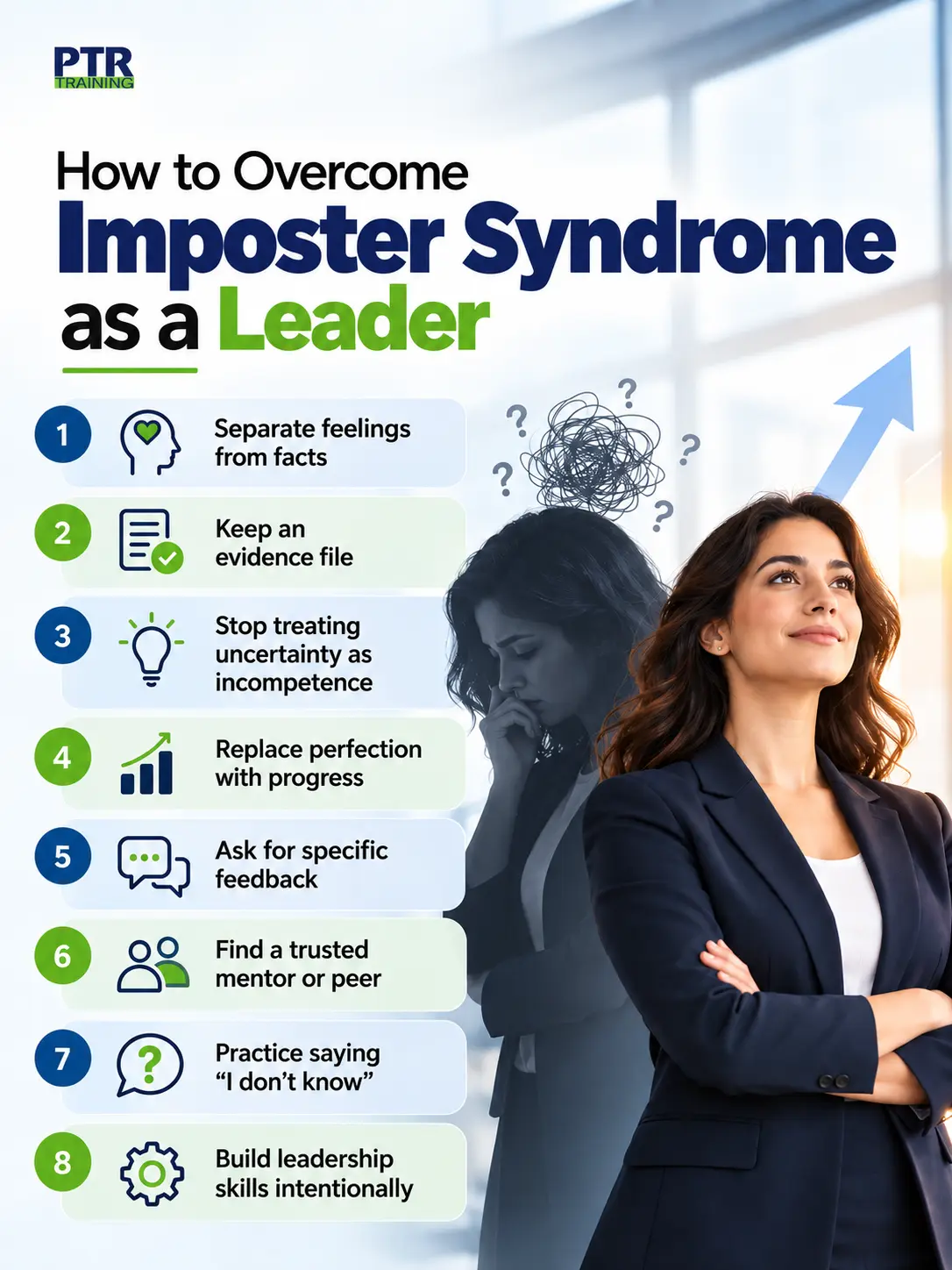
1. Separate feelings from facts
When you think, “I am not qualified for this,” pause.
Ask yourself:
What evidence supports this belief?
Then ask:
What evidence contradicts it?
Write down your experience, results, skills, feedback, promotions, completed projects, and challenges you have successfully handled.
This turns a vague feeling into something you can evaluate.
2. Keep an evidence file
Create a simple record of accomplishments.
Include:
- Successful projects
- Positive feedback
- Goals you achieved
- Problems you solved
- Skills you developed
- Difficult situations you handled
- Contributions made by your team under your leadership
Review it when self-doubt becomes loud.
You are not trying to convince yourself that you are perfect. You are reminding yourself to evaluate your performance fairly.
3. Stop treating uncertainty as incompetence
Leadership rarely comes with complete information.
Instead of asking:
“Do I know everything?”
Ask:
“Do I know enough to make the next responsible decision?”
That is a much more useful leadership question.
4. Replace perfection with progress
Set standards that challenge you without making unacceptable mistakes.
A strong leader can say:
- “This is the best decision based on what we know today.”
- “We will adjust if new information changes the situation.”
- “I could have handled that conversation better.”
- “Here is what I learned.”
Learning from mistakes is different from being defined by them.
5. Ask for specific feedback
General feedback such as “How am I doing?” can be difficult to use.
Instead, ask:
- “What is one leadership behavior I should continue?”
- “Where could I communicate more clearly?”
- “What should I do differently in our next project?”
- “What strength do you think I should use more often?”
Specific questions produce more useful information.
6. Find a trusted mentor or peer
You do not have to work through leadership uncertainty alone.
A mentor can help you see situations from a broader perspective. A trusted peer can remind you that leadership challenges are rarely unique.
Choose someone who will challenge you honestly rather than simply reassure you.
7. Practice saying “I don’t know”
This may feel uncomfortable at first. Admitting you do not know something can demonstrate confidence when paired with action.
Try:
“I don’t know yet, but I’ll find out.”
That statement shows humility, accountability, and a commitment to follow through.
8. Build leadership skills intentionally
Sometimes confidence grows because your skills grow.
Identify the leadership capabilities you want to strengthen, such as delegation, communication, decision-making, coaching, or conflict management.
Targeted leadership development can give you practical tools to handle situations that previously created uncertainty.
Turn Self-Doubt Into Greater Confidence
If self-doubt is affecting how you lead, communicate, or make decisions, targeted professional development can provide practical strategies for building confidence.
Developing self-awareness can help you recognize unhelpful thought patterns, challenge negative assumptions, and approach professional challenges with a more balanced view of your abilities.
How Managers Can Support Employees Experiencing Imposter Feelings
Imposter syndrome in the workplace can affect employees at different career stages, including newly promoted managers, experienced professionals, and senior leaders.
A few simple practices can make a meaningful difference:
- Give specific recognition: Explain what the employee did well and why it mattered.
- Provide useful feedback: Give clear guidance on what they can improve and what they should continue doing.
- Normalize learning: Remind employees that new responsibilities come with a learning curve.
- Create opportunities for growth: Give employees meaningful projects that help them develop new skills.
- Encourage questions: Make it safe for employees to ask for clarification or acknowledge when they need help.
- Supportive mentoring: Connect employees with experienced colleagues who can provide perspective and guidance.
The goal is not to eliminate every moment of self-doubt. Instead, managers can create an environment where employees have the support, feedback, and opportunities they need to build genuine confidence.
Strong leadership starts with developing people, not simply managing performance.

Estimate the potential return of your workforce training investment with PTR Training's Training Impact Calculator.
Calculate Training ROIA Simple 5-Step Leadership Confidence Checklist
When imposter feelings appear, use this quick process:
- Name the thought
What are you telling yourself? - Check the evidence
What facts support or challenge that belief? - Identify the next action
What is one productive thing you can do now? - Ask for perspective
Who can give you honest and constructive feedback? - Record the result
What did you learn after taking action?
The goal is not to become fearless.
The goal is to become more comfortable acting responsibly even when you do not feel completely certain.
Frequently Asked Questions
Can a promotion trigger imposter syndrome?
Yes. A promotion can trigger imposter feelings because your responsibilities, visibility, and expectations suddenly increase. You may feel comfortable in your previous role but question whether you are ready for the next one. This is particularly common when you begin managing former peers or making decisions with broader business consequences. Giving yourself time to adjust, seeking feedback, and focusing on learning can help you settle into the new role.
Is imposter syndrome a sign of poor leadership?
No. Experiencing imposter feelings does not mean you are an ineffective leader. Self-doubt can affect highly capable professionals, particularly during periods of change or increased responsibility. The important factor is how you respond to those feelings. If you use reflection, feedback, and learning to improve your leadership, uncertainty can become an opportunity for growth rather than a barrier.
Can imposter syndrome cause leaders to overwork?
It can. A leader who feels they must constantly prove their competence may take on too much work, over-prepare for routine situations, or struggle to delegate. While extra effort may provide temporary reassurance, it can become exhausting over time. Setting realistic expectations, trusting your team, and recognizing your actual contributions can help break this cycle.
Should leaders tell their teams when they experience self-doubt?
There is no need to share every personal doubt with your team. However, appropriate vulnerability can help foster a culture in which people understand that leaders do not have all the answers. You can acknowledge uncertainty while remaining accountable, such as by saying, “I don’t have the answer yet, but I’ll find out.” The goal is to model thoughtful leadership, not transfer your anxiety to the team.
Does imposter syndrome go away with more experience?
Not necessarily. Greater experience can strengthen your skills and confidence, but new responsibilities can also introduce new forms of uncertainty. A senior leader may feel confident managing a familiar challenge but experience self-doubt when entering a new market, leading a larger team, or taking on an executive role. Learning to manage self-doubt is often more useful than expecting it to disappear completely.
Final Thoughts
Effective leadership does not require complete certainty. It requires the ability to make thoughtful decisions, learn from experience, accept feedback, and continue developing your skills.
PTR Training offers leadership and management training for emerging leaders, managers, and experienced executives.
Explore Accountable Leadership for Managers to strengthen decision-making, delegation, communication, coaching, feedback, accountability, and trust.