The Importance of Strategic Thinking in Leadership

Strategic Thinking in Leadership

Leadership today requires more than managing teams and handling daily operations; it involves strategic thinking that evaluates long-term impacts. Clarifying this distinction helps readers understand why strategic thinking is an essential leadership skill in fast-changing environments. 

Whether leading a department or an entire organization, strategic thinking improves decision-making, innovation, and business performance. In this blog, you will learn the importance of strategic thinking in leadership, how it enhances leadership effectiveness, and the key skills that help leaders drive long-term success.

What Is Strategic Thinking in Leadership?

Strategic thinking in leadership is the ability to evaluate situations with a long-term perspective while making decisions that support organizational growth and future success.

Rather than focusing only on immediate tasks or short-term goals, strategic leaders analyze trends, anticipate challenges, and identify opportunities before they become obvious. They understand how today’s decisions can influence tomorrow’s results.

In many organizations, leaders are often consumed by operational responsibilities. While daily execution is important, businesses also need leaders who can step back and evaluate the bigger picture. Strategic thinking allows leaders to connect individual actions with broader business objectives.

A strategic leader typically focuses on:

  • Long-term business growth
  • Organizational alignment
  • Innovation and adaptability
  • Risk management
  • Market awareness
  • Sustainable decision-making

Strong leadership and strategic thinking go hand in hand because leadership requires direction, and strategic thinking provides the roadmap that builds confidence in decision-making.

Why Strategic Thinking Matters for Modern Leaders?

Businesses today face rapid change, evolving customer expectations, and constant disruption. Strategic thinking helps leaders anticipate challenges, adapt proactively, and make long-term decisions rather than react only to immediate problems.

For example, during periods of market disruption, organizations with strategic leadership were able to adapt faster by improving digital operations, adjusting business models, and responding proactively to customer needs.

Strategic thinking helps leaders:

  • Make informed business decisions
  • Prioritize long-term goals over short-term pressure
  • Improve organizational agility
  • Strengthen innovation
  • Build resilient teams
  • Identify growth opportunities earlier
  • Manage uncertainty more effectively

A leader who thinks strategically creates clarity for teams. Employees understand not only what they are doing, but also why it matters to the organization’s future, fostering a sense of purpose and motivation.

How Strategic Thinking Enhances Leadership?

One of the main reasons organizations value strategic leaders is that strategic thinking enhances leadership at every level. It influences how leaders communicate, solve problems, manage change, and guide organizations toward growth.
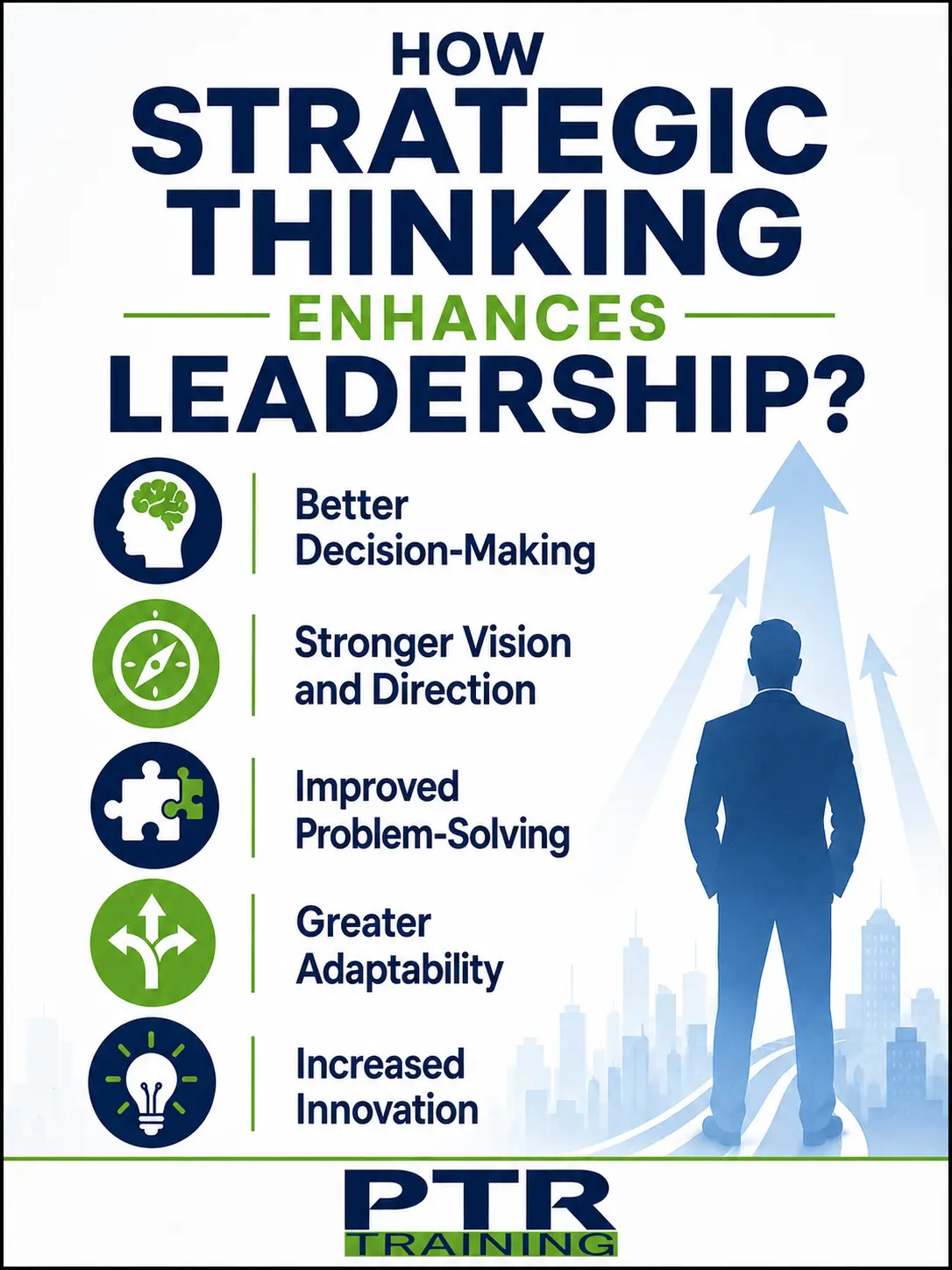
how strategic thinking enhances leadership

Better Decision-Making

Strategic leaders evaluate both immediate and long-term consequences before making decisions. Instead of reacting emotionally or rushing into solutions, they carefully assess risks, opportunities, and business impact. This leads to more balanced and strategic decision-making.

For example, a strategic leader may delay a short-term gain if it creates long-term operational risk. That perspective helps organizations avoid costly mistakes.

Stronger Vision and Direction

Teams perform better when they understand where the organization is heading. Strategic leaders communicate a clear vision and connect everyday responsibilities to larger business goals—creating a stronger sense of purpose across departments.

When employees understand how their work contributes to organizational success, productivity and engagement often improve naturally.

Improved Problem-Solving

Every organization faces challenges, but strategic leaders approach problems differently. Instead of only fixing symptoms, they focus on identifying root causes and evaluating multiple solutions before taking action.

This approach improves long-term outcomes and reduces recurring issues.

Greater Adaptability

Adaptability has become one of the most important leadership qualities in modern business.

Strategic thinking allows leaders to monitor trends, anticipate disruption, and prepare organizations for change before challenges become critical, fostering confidence and resilience in uncertain environments.

Increased Innovation

Innovation rarely happens without strategic thinking. Leaders who constantly focus only on operational tasks often miss opportunities for improvement and growth. Strategic leaders encourage curiosity, continuous learning, and forward-thinking ideas.

This mindset helps organizations remain competitive in evolving markets.

Developing strategic thinking skills is possible at all levels of leadership.

For example, practicing scenario planning or engaging in SWOT analysis can strengthen skills like critical thinking and adaptability, making the concept more tangible and actionable for readers.

Strategic thinking is not limited to senior executives. It is a skill that leaders at every level can develop and strengthen over time. Below are some of the most important strategic thinking skills in leadership.

Strategic Skill Why It Matters
Critical Thinking Helps leaders analyze situations objectively
Communication Aligns teams around strategic goals
Problem-Solving Improves decision-making quality
Emotional Intelligence Builds stronger workplace relationships
Data Analysis Supports informed business decisions
Adaptability Helps leaders respond to market changes
Innovation Encourages business growth and improvement

Critical Thinking

Strategic leaders avoid making assumptions too quickly. They ask questions, evaluate information carefully, and consider multiple perspectives before making decisions. Critical thinking improves judgment and reduces reactive decision-making.

Communication Skills

Even the best strategy can fail without effective communication. Strategic leaders clearly explain goals, priorities, and expectations so teams remain aligned and focused. Strong communication also helps build trust within organizations.

Emotional Intelligence

Leadership and strategic thinking are closely connected to emotional intelligence. Leaders who understand team dynamics, employee concerns, and workplace behavior often make better decisions and create healthier organizational cultures.

Data-Driven Thinking

Modern business decisions increasingly rely on data. Strategic leaders use performance metrics, market research, and analytics to guide decisions rather than relying solely on intuition.

The Relationship Between Leadership and Strategic Thinking

Leadership and strategic thinking are deeply interconnected. Leadership is about influencing people and guiding organizations toward success. Strategic thinking ensures that leadership decisions support long-term goals rather than only short-term results.

Without strategic thinking, leadership can become reactive and inconsistent.

Without leadership, strategy often remains an idea without execution.

Together, they help organizations:

  • Create a clear direction
  • Improve organizational focus
  • Strengthen accountability
  • Build resilient workplace cultures
  • Respond effectively to change

Organizations increasingly seek leaders who can balance operational management with long-term strategic vision.

Common Leadership Challenges Without Strategic Thinking

Leaders who lack strategic thinking often struggle to manage growth, change, and uncertainty effectively.

One common issue is short-term decision-making. Leaders under pressure may focus only on immediate results, neglecting long-term consequences. This can lead to poor investments, employee burnout, or operational inefficiencies.

Another challenge is organizational misalignment. Without a clear strategic direction, departments may work toward different priorities, reducing overall business effectiveness.

Organizations also struggle during periods of disruption when leadership lacks strategic preparation. Reactive leadership often creates confusion, delays, and inconsistent decision-making during uncertain situations.

These challenges highlight why strategic thinking leadership is essential for sustainable business success.

Practical Ways to Improve Strategic Thinking

Strategic thinking is a skill that improves with intentional practice and continuous learning. Here are several practical ways to strengthen your strategic thinking abilities.

Focus on Long-Term Goals

Avoid making decisions based only on immediate pressure or short-term gains.

Ask yourself:

  • How will this decision affect the organization next year?
  • Does this align with long-term business objectives?
  • What future risks or opportunities could emerge?

This habit improves leadership perspective over time.

Stay Informed About Industry Trends

Strategic leaders consistently monitor industry developments, market trends, customer expectations, and emerging technologies. Continuous learning helps leaders anticipate change before competitors do.

Encourage Diverse Perspectives

Great leaders understand the value of collaboration. Seeking input from employees, department leaders, customers, and industry experts often reveals opportunities or risks that may otherwise go unnoticed.

Strengthen Data Literacy

Modern leadership requires data-driven thinking. Leaders who understand analytics and performance metrics are better equipped to make strategic decisions confidently.

Practice Scenario Planning

Strategic leaders prepare for multiple possible outcomes rather than relying on a single plan.

Scenario planning helps organizations remain flexible during:

  • Economic changes
  • Market disruptions
  • Technology shifts
  • Customer behavior changes

This improves organizational resilience and adaptability.

Build Stronger Leaders Through Strategic Thinking

Organizations that invest in strategic leadership development are better prepared to manage change, improve decision-making, and drive long-term growth. Leadership and management training programs focused on strategic thinking help professionals strengthen communication, innovation, adaptability, and business planning skills.

Explore leadership development solutions designed to help your teams lead confidently in evolving business environments.

Frequently Asked Questions

Why is strategic thinking important in leadership?

Strategic thinking helps leaders make informed decisions, anticipate change, align teams with organizational goals, and improve long-term business performance.

How does strategic thinking enhance leadership performance?

Strategic thinking enhances leadership by improving decision-making, communication, innovation, adaptability, and problem-solving capabilities.

Can strategic thinking skills be developed?

Yes. Strategic thinking skills in leadership can be strengthened through continuous learning, industry research, data analysis, mentorship, and real-world experience.

What are the most important strategic thinking skills for leaders?

Critical thinking, communication, adaptability, emotional intelligence, innovation, and data analysis are among the most valuable strategic leadership skills.

What is the relationship between leadership and strategic thinking?

Leadership focuses on guiding people and organizations, while strategic thinking helps leaders create long-term plans and make decisions that support sustainable success.

Conclusion

Strategic thinking is essential for modern leadership. It helps leaders make informed decisions, adapt to change, drive innovation, and support long-term business growth. Organizations that develop strong strategic leaders are better prepared to navigate challenges, align teams effectively, and achieve sustainable success in an evolving business environment.


You May Also Like

Leadership SkillsBusiness Skills
Strategic Thinking in Leadership

The Importance of Strategic Thinking in Leadership

Strategic Thinking in Leadership

Leadership today requires more than managing teams and handling daily operations; it involves strategic thinking that evaluates long-term impacts. Clarifying this distinction helps readers understand why strategic thinking is an essential leadership skill in fast-changing environments. 

Whether leading a department or an entire organization, strategic thinking improves decision-making, innovation, and business performance. In this blog, you will learn the importance of strategic thinking in leadership, how it enhances leadership effectiveness, and the key skills that help leaders drive long-term success.

What Is Strategic Thinking in Leadership?

Strategic thinking in leadership is the ability to evaluate situations with a long-term perspective while making decisions that support organizational growth and future success.

Rather than focusing only on immediate tasks or short-term goals, strategic leaders analyze trends, anticipate challenges, and identify opportunities before they become obvious. They understand how today’s decisions can influence tomorrow’s results.

In many organizations, leaders are often consumed by operational responsibilities. While daily execution is important, businesses also need leaders who can step back and evaluate the bigger picture. Strategic thinking allows leaders to connect individual actions with broader business objectives.

A strategic leader typically focuses on:

  • Long-term business growth
  • Organizational alignment
  • Innovation and adaptability
  • Risk management
  • Market awareness
  • Sustainable decision-making

Strong leadership and strategic thinking go hand in hand because leadership requires direction, and strategic thinking provides the roadmap that builds confidence in decision-making.

Why Strategic Thinking Matters for Modern Leaders?

Businesses today face rapid change, evolving customer expectations, and constant disruption. Strategic thinking helps leaders anticipate challenges, adapt proactively, and make long-term decisions rather than react only to immediate problems.

For example, during periods of market disruption, organizations with strategic leadership were able to adapt faster by improving digital operations, adjusting business models, and responding proactively to customer needs.

Strategic thinking helps leaders:

  • Make informed business decisions
  • Prioritize long-term goals over short-term pressure
  • Improve organizational agility
  • Strengthen innovation
  • Build resilient teams
  • Identify growth opportunities earlier
  • Manage uncertainty more effectively

A leader who thinks strategically creates clarity for teams. Employees understand not only what they are doing, but also why it matters to the organization’s future, fostering a sense of purpose and motivation.

How Strategic Thinking Enhances Leadership?

One of the main reasons organizations value strategic leaders is that strategic thinking enhances leadership at every level. It influences how leaders communicate, solve problems, manage change, and guide organizations toward growth.

how strategic thinking enhances leadership

Better Decision-Making

Strategic leaders evaluate both immediate and long-term consequences before making decisions. Instead of reacting emotionally or rushing into solutions, they carefully assess risks, opportunities, and business impact. This leads to more balanced and strategic decision-making.

For example, a strategic leader may delay a short-term gain if it creates long-term operational risk. That perspective helps organizations avoid costly mistakes.

Stronger Vision and Direction

Teams perform better when they understand where the organization is heading. Strategic leaders communicate a clear vision and connect everyday responsibilities to larger business goals—creating a stronger sense of purpose across departments.

When employees understand how their work contributes to organizational success, productivity and engagement often improve naturally.

Improved Problem-Solving

Every organization faces challenges, but strategic leaders approach problems differently. Instead of only fixing symptoms, they focus on identifying root causes and evaluating multiple solutions before taking action.

This approach improves long-term outcomes and reduces recurring issues.

Greater Adaptability

Adaptability has become one of the most important leadership qualities in modern business.

Strategic thinking allows leaders to monitor trends, anticipate disruption, and prepare organizations for change before challenges become critical, fostering confidence and resilience in uncertain environments.

Increased Innovation

Innovation rarely happens without strategic thinking. Leaders who constantly focus only on operational tasks often miss opportunities for improvement and growth. Strategic leaders encourage curiosity, continuous learning, and forward-thinking ideas.

This mindset helps organizations remain competitive in evolving markets.

Developing strategic thinking skills is possible at all levels of leadership.

For example, practicing scenario planning or engaging in SWOT analysis can strengthen skills like critical thinking and adaptability, making the concept more tangible and actionable for readers.

Strategic thinking is not limited to senior executives. It is a skill that leaders at every level can develop and strengthen over time. Below are some of the most important strategic thinking skills in leadership.

Strategic Skill Why It Matters
Critical Thinking Helps leaders analyze situations objectively
Communication Aligns teams around strategic goals
Problem-Solving Improves decision-making quality
Emotional Intelligence Builds stronger workplace relationships
Data Analysis Supports informed business decisions
Adaptability Helps leaders respond to market changes
Innovation Encourages business growth and improvement

Critical Thinking

Strategic leaders avoid making assumptions too quickly. They ask questions, evaluate information carefully, and consider multiple perspectives before making decisions. Critical thinking improves judgment and reduces reactive decision-making.

Communication Skills

Even the best strategy can fail without effective communication. Strategic leaders clearly explain goals, priorities, and expectations so teams remain aligned and focused. Strong communication also helps build trust within organizations.

Emotional Intelligence

Leadership and strategic thinking are closely connected to emotional intelligence. Leaders who understand team dynamics, employee concerns, and workplace behavior often make better decisions and create healthier organizational cultures.

Data-Driven Thinking

Modern business decisions increasingly rely on data. Strategic leaders use performance metrics, market research, and analytics to guide decisions rather than relying solely on intuition.

The Relationship Between Leadership and Strategic Thinking

Leadership and strategic thinking are deeply interconnected. Leadership is about influencing people and guiding organizations toward success. Strategic thinking ensures that leadership decisions support long-term goals rather than only short-term results.

Without strategic thinking, leadership can become reactive and inconsistent.

Without leadership, strategy often remains an idea without execution.

Together, they help organizations:

  • Create a clear direction
  • Improve organizational focus
  • Strengthen accountability
  • Build resilient workplace cultures
  • Respond effectively to change

Organizations increasingly seek leaders who can balance operational management with long-term strategic vision.

Common Leadership Challenges Without Strategic Thinking

Leaders who lack strategic thinking often struggle to manage growth, change, and uncertainty effectively.

One common issue is short-term decision-making. Leaders under pressure may focus only on immediate results, neglecting long-term consequences. This can lead to poor investments, employee burnout, or operational inefficiencies.

Another challenge is organizational misalignment. Without a clear strategic direction, departments may work toward different priorities, reducing overall business effectiveness.

Organizations also struggle during periods of disruption when leadership lacks strategic preparation. Reactive leadership often creates confusion, delays, and inconsistent decision-making during uncertain situations.

These challenges highlight why strategic thinking leadership is essential for sustainable business success.

Practical Ways to Improve Strategic Thinking

Strategic thinking is a skill that improves with intentional practice and continuous learning. Here are several practical ways to strengthen your strategic thinking abilities.

Focus on Long-Term Goals

Avoid making decisions based only on immediate pressure or short-term gains.

Ask yourself:

  • How will this decision affect the organization next year?
  • Does this align with long-term business objectives?
  • What future risks or opportunities could emerge?

This habit improves leadership perspective over time.

Stay Informed About Industry Trends

Strategic leaders consistently monitor industry developments, market trends, customer expectations, and emerging technologies. Continuous learning helps leaders anticipate change before competitors do.

Encourage Diverse Perspectives

Great leaders understand the value of collaboration. Seeking input from employees, department leaders, customers, and industry experts often reveals opportunities or risks that may otherwise go unnoticed.

Strengthen Data Literacy

Modern leadership requires data-driven thinking. Leaders who understand analytics and performance metrics are better equipped to make strategic decisions confidently.

Practice Scenario Planning

Strategic leaders prepare for multiple possible outcomes rather than relying on a single plan.

Scenario planning helps organizations remain flexible during:

  • Economic changes
  • Market disruptions
  • Technology shifts
  • Customer behavior changes

This improves organizational resilience and adaptability.

Build Stronger Leaders Through Strategic Thinking

Organizations that invest in strategic leadership development are better prepared to manage change, improve decision-making, and drive long-term growth. Leadership and management training programs focused on strategic thinking help professionals strengthen communication, innovation, adaptability, and business planning skills.

Explore leadership development solutions designed to help your teams lead confidently in evolving business environments.

Frequently Asked Questions

Why is strategic thinking important in leadership?

Strategic thinking helps leaders make informed decisions, anticipate change, align teams with organizational goals, and improve long-term business performance.

How does strategic thinking enhance leadership performance?

Strategic thinking enhances leadership by improving decision-making, communication, innovation, adaptability, and problem-solving capabilities.

Can strategic thinking skills be developed?

Yes. Strategic thinking skills in leadership can be strengthened through continuous learning, industry research, data analysis, mentorship, and real-world experience.

What are the most important strategic thinking skills for leaders?

Critical thinking, communication, adaptability, emotional intelligence, innovation, and data analysis are among the most valuable strategic leadership skills.

What is the relationship between leadership and strategic thinking?

Leadership focuses on guiding people and organizations, while strategic thinking helps leaders create long-term plans and make decisions that support sustainable success.

Conclusion

Strategic thinking is essential for modern leadership. It helps leaders make informed decisions, adapt to change, drive innovation, and support long-term business growth. Organizations that develop strong strategic leaders are better prepared to navigate challenges, align teams effectively, and achieve sustainable success in an evolving business environment.