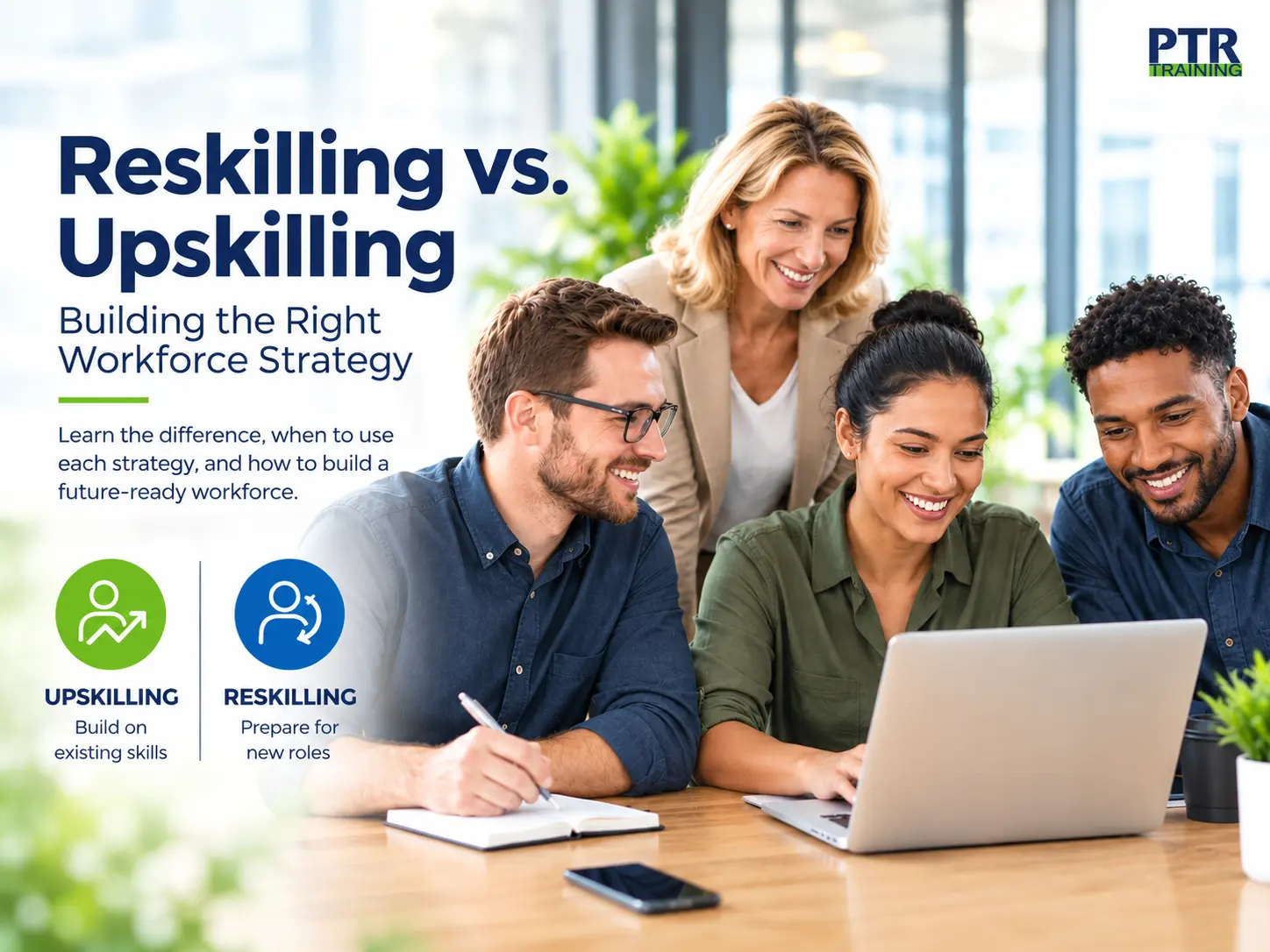
The skills your workforce needs today may not be the skills your organization needs tomorrow. New technology, changing customer expectations, automation, and evolving business priorities are reshaping jobs across industries.
For HR leaders, managers, and organizational decision-makers, that creates an important question: Should you improve the skills employees already have, or prepare them for entirely different roles?
That is where understanding the difference between reskilling and upskilling becomes important.
Why Workforce Skills Are Changing
Workforce development is no longer something you can treat as an occasional training initiative.
Technology is changing how employees work. Artificial intelligence is influencing job responsibilities. Businesses are adopting new tools. At the same time, some roles are changing while others are emerging.
The World Economic Forum's Future of Jobs Report 2025 found that 63% of employers consider skills gaps a major barrier to business transformation. The same report found that 85% of employers expect upskilling to be a key workforce strategy between 2025 and 2030.
The need for workforce development is also broad.
According to the report, for every 100 workers, employers expect 29 to require upskilling within their current roles and 19 to require training before being reskilled and redeployed into other roles by 2030.
That means organizations cannot rely on hiring alone to solve future skill shortages.
You need a strategy for developing the people you already have.
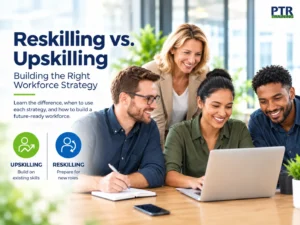
What Is Upskilling?
Upskilling means teaching an employee new or advanced skills for their current job. It builds on what they know instead of replacing it.
A project manager learning AI tools, advanced data analysis, or new project management methods to perform their existing role more effectively is upskilling. The role stays the same. The capability inside that role grows.
Upskilling is usually the faster, lower-cost path. It works well when your team's job functions are stable, but the tools, technology, or expectations around those functions are evolving.
What Is Reskilling?
Reskilling means training an employee for a different role entirely, often because their current role is shrinking, changing significantly, or being automated.
An administrative professional transitioning into a data or business operations role after developing new technical and analytical skills is reskilling. A customer service representative moving into a technical support role after learning new systems is reskilling. The person stays with your company. Their function changes.
Reskilling takes longer and costs more upfront. It pays off when you want to retain institutional knowledge and loyalty instead of losing that talent to layoffs and rehiring elsewhere.
Organizations can support these strategies through targeted professional development, leadership training, technology training, communication programs, and other role-specific learning opportunities.
PTR Training offers workforce development programs designed to help organizations build the capabilities their employees need as business requirements evolve.
Estimate the potential return of your workforce training investment with PTR Training's Training Impact Calculator.
Calculate Training ROI
Upskilling vs. Reskilling: Why Both Strategies Matter
Organizations often ask whether they should focus on upskilling or reskilling.
The better question is:
What does your workforce need to accomplish your future business goals?
The answer may involve both.
The World Economic Forum reports that 77% of employers expect to reskill or upskill their existing workforce in response to AI adoption by 2030.
The business case is also broader than simply closing a skills gap.
Employers surveyed by the World Economic Forum identified enhanced productivity as the leading expected outcome of workforce training, cited by 77% of respondents. Improved competitiveness followed at 70%.
A thoughtful development strategy can help you:
- Close critical skill gaps
- Improve employee productivity
- Prepare teams for new technology
- Support internal mobility
- Strengthen leadership pipelines
- Improve employee retention
- Reduce dependence on external hiring
- Preserve institutional knowledge
- Support organizational change
For HR and business leaders, this makes employee development a workforce strategy rather than simply an HR benefit.
5 Effective Strategies for Upskilling and Reskilling Employees
A successful workforce development strategy needs more than training courses. It requires a clear plan that connects employee development with your organization's future business needs.
The following five strategies can help HR leaders and managers identify skill gaps, create targeted learning opportunities, and measure whether development efforts are producing meaningful results.
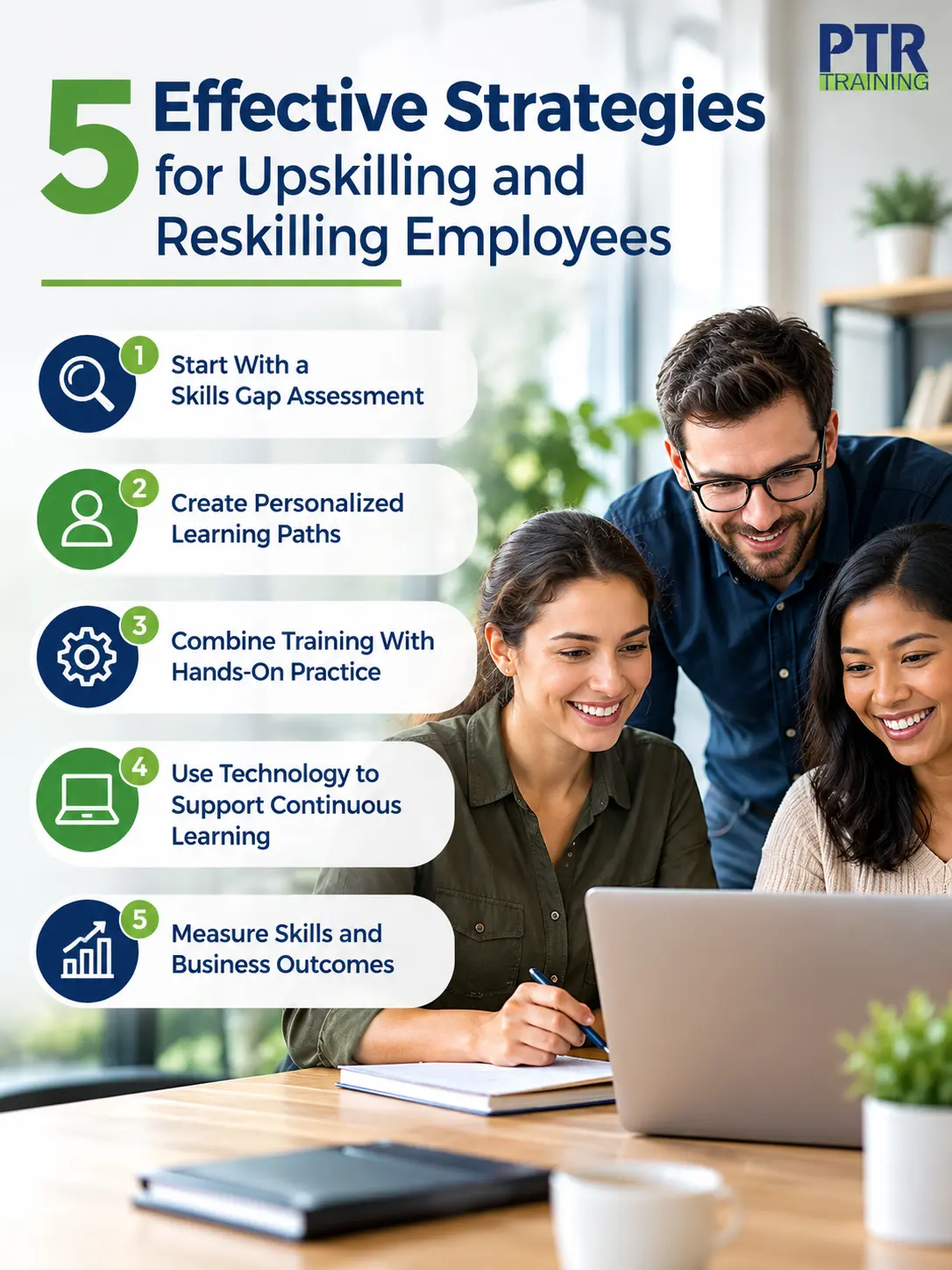
1. Start With a Skills Gap Assessment
Start by mapping your organization's critical roles and identifying the skills those roles will require over the next two to three years. Then compare those requirements with the capabilities employees currently have.
Use performance reviews, skills assessments, manager feedback, project requirements, and workforce data to identify the most important gaps. Prioritize skills that directly support business goals rather than trying to address every gap at once.
For example, if your organization is introducing AI-powered tools, assess which employees need additional AI and digital skills to perform their current roles and which roles may require entirely different capabilities. This can help you determine where upskilling makes sense and where reskilling may be more appropriate.
2. Create Personalized Learning Paths
Avoid giving every employee the same training simply because they work in the same department. Instead, create learning paths based on an employee's current skills, role requirements, career goals, and the organization's future needs.
Start by grouping employees according to their skill gaps and development needs. An employee who needs stronger data analysis skills for their current position may follow an upskilling path, while an employee preparing to move into a new function may need a reskilling path.
Define the specific skills employees need to develop, recommend relevant training, and give them opportunities to apply those skills on the job. Managers can then review progress and adjust learning plans as business requirements change.
3. Combine Training With Hands-On Practice
Training should not end when a course or workshop is completed. Give employees opportunities to use new skills in realistic work situations.
After training, assign a project, stretch assignment, job rotation, or workplace challenge that requires employees to apply what they have learned. Managers can reinforce the learning through coaching, mentoring, and regular feedback.
For example, after employees complete training on a new software platform, give them a real business task that requires them to use the platform rather than relying on demonstrations alone. This helps turn training knowledge into practical capability.
4. Use Technology to Support Continuous Learning
Make learning part of the employee's ongoing development rather than an occasional training event. Use online resources, digital learning platforms, virtual training, and AI-enabled tools to give employees flexible ways to build skills alongside their regular responsibilities.
HR teams can also use workforce data to identify emerging skill requirements and recommend relevant learning opportunities. Managers can reinforce this process by discussing development goals during regular one-on-one meetings and performance reviews.
The goal is not to add more training to employees' schedules. It is to make learning accessible, relevant, and connected to the skills employees actually need to perform and grow.
5. Measure Skills and Business Outcomes
Measure whether training is producing stronger capabilities, not simply whether employees completed a course. Before launching a program, define what successful skill development should look like and how it will support business objectives.
Track measures such as skill proficiency, time to proficiency, productivity, employee performance, internal mobility, promotion rates, retention, and adoption of new technologies. Managers can also assess whether employees are applying their new capabilities effectively in their roles.
Review these results regularly and use them to refine future learning programs. If employees complete training but do not demonstrate the expected improvement, the organization may need additional practice, coaching, or a different learning approach.
Building a Workforce That's Ready for What's Next
An organization might upskill most employees whose roles are evolving while reskilling a smaller group whose current responsibilities are being significantly transformed. Together, these approaches can help organizations retain valuable talent while building capabilities for future business needs.
Ready to build a workforce strategy that fits your organization? PTR's Leadership Skills for Employee Growth and Professional Development training program focuses on building learning cultures, encouraging professional development, using performance reviews to identify development needs, and supporting ongoing training.

Estimate the potential return of your workforce training investment with PTR Training's Training Impact Calculator.
Calculate Training ROIFrequently Asked Questions
What is the difference between upskilling and reskilling?
Upskilling adds new skills to an employee's current role. Reskilling trains an employee for a different role. Upskilling deepens expertise; reskilling changes direction entirely.
Is reskilling better than upskilling?
Neither is universally better. The right choice depends on your business needs. If a role is evolving, upskilling may be the better approach. If a role is declining or your organization needs employees to move into different functions, reskilling may be more appropriate. Many organizations need both strategies.
How do you upskill and reskill employees?
Start by identifying future business needs and assessing your employees' current capabilities. Then identify skill gaps and determine whether each employee needs stronger skills for their current role or new skills for a different role. Use training, coaching, mentoring, projects, cross-training, and hands-on practice. Finally, measure business outcomes.
How can HR leaders decide between reskilling and upskilling?
Start with the future of the role. If the role will continue but require additional capabilities, prioritize upskilling. If the role is declining or employees need to move into different functions, consider reskilling. Use skills assessments and workforce planning data to make the decision rather than relying on job titles alone.
When should a company reskill vs. upskill employees?
Upskill when job functions are stable but tools or expectations are evolving. Reskill when a role is shrinking, being automated, or disappearing, and you want to retain the employee in a different capacity.
What are the benefits of reskilling and upskilling?
Reskilling and upskilling help organizations close skill gaps, improve productivity, support internal mobility, and prepare employees for changing business needs. They can also strengthen employee development, reduce reliance on external hiring, and help organizations adapt to new technologies.
Why is upskilling important for employee retention?
Providing opportunities to develop new skills can signal that an organization is invested in employee growth. When employees can see opportunities to learn, take on new responsibilities, and progress internally, professional development can become an important part of the employee experience.
Read also: How to Improve Communication Skills in the Workplace?
Final Thoughts
The difference between reskilling and upskilling comes down to where you are taking your employees.
Upskilling helps people become more capable in their existing roles.
Reskilling helps people prepare for different roles.
Both can play an important role in building a workforce that can adapt to changing business demands.
The goal isn't to choose reskilling over upskilling. It's about understanding where your workforce is going and determining what each employee needs to get there.
For HR leaders and managers, the goal should not be to train employees simply because new courses are available.
The goal is to develop the right skills, for the right people, at the right time, based on where the business is going.
That means assessing your current workforce, identifying future skill requirements, and creating targeted development paths that connect employee growth with organizational goals.
Whether your workforce needs stronger leadership capabilities, better technology skills, improved communication, or preparation for changing roles, the right training strategy can help you turn skill gaps into opportunities.
Build the skills your workforce needs next. Explore PTR Training's workforce and professional development training programs to help employees strengthen existing capabilities, prepare for changing responsibilities, and develop the skills needed for future roles.