

Every workday asks you to make choices. Some are small and routine. Others affect deadlines, budgets, team morale, or customer outcomes. The challenge is not just making decisions quickly. It is making decisions that are clear, practical, and well thought out.
That is why learning how to improve decision-making skills matters so much in the workplace. Strong decision-makers do not rely on guesswork alone. They gather the right information, weigh options carefully, and move forward with confidence. Over time, this helps you become more trusted, more productive, and more effective in your role.
What Are Effective Decision-Making Skills?
Effective decision-making skills are the abilities that help you evaluate a situation, understand your options, and choose the best next step. These skills are not limited to managers. They are useful in every role and at every career stage.
According to Harvard’s career guidance, good decision-making at work involves assessing facts, understanding goals, and selecting a practical course of action. It also draws on multiple supporting skills, not just logic alone.
Here are some of the most effective decision-making skills in the workplace:
1. Analytical thinking
You need to look at information clearly and separate facts from assumptions. This helps you make decisions based on evidence instead of impulse.
2. Critical thinking
Critical thinking helps you question ideas, spot weak points, and compare possible outcomes before taking action.
3. Problem-solving
Many workplace decisions are really problem-solving moments. You are trying to fix something, improve something, or prevent something from getting worse.
4. Self-awareness
You make better decisions when you understand your own habits, blind spots, and emotional triggers. Self-awareness helps you pause before reacting too quickly.
5. Communication
A good decision is easier to carry out when you can explain it clearly. Communication also helps when you need input from others before deciding.
6. Collaboration
You do not always need to decide alone. Asking the right people for context or feedback often improves the final outcome. Harvard also notes that asking for help can expose you to methods and perspectives you may not have considered.
7. Leadership
Leadership is not only about authority. It is also about taking ownership, making thoughtful calls, and helping others move forward with confidence.
8. Reflection
One of the most overlooked skills is the ability to review past decisions honestly. Reflection helps you learn what worked, what did not, and what to change next time.
7 Ways to Improve Decision-Making Skills in the Workplace
If you want to improve your decision-making skills, focus on habits you can use consistently. You do not need a complex system. You need a clear approach that helps you think better, act faster, and learn from experience.
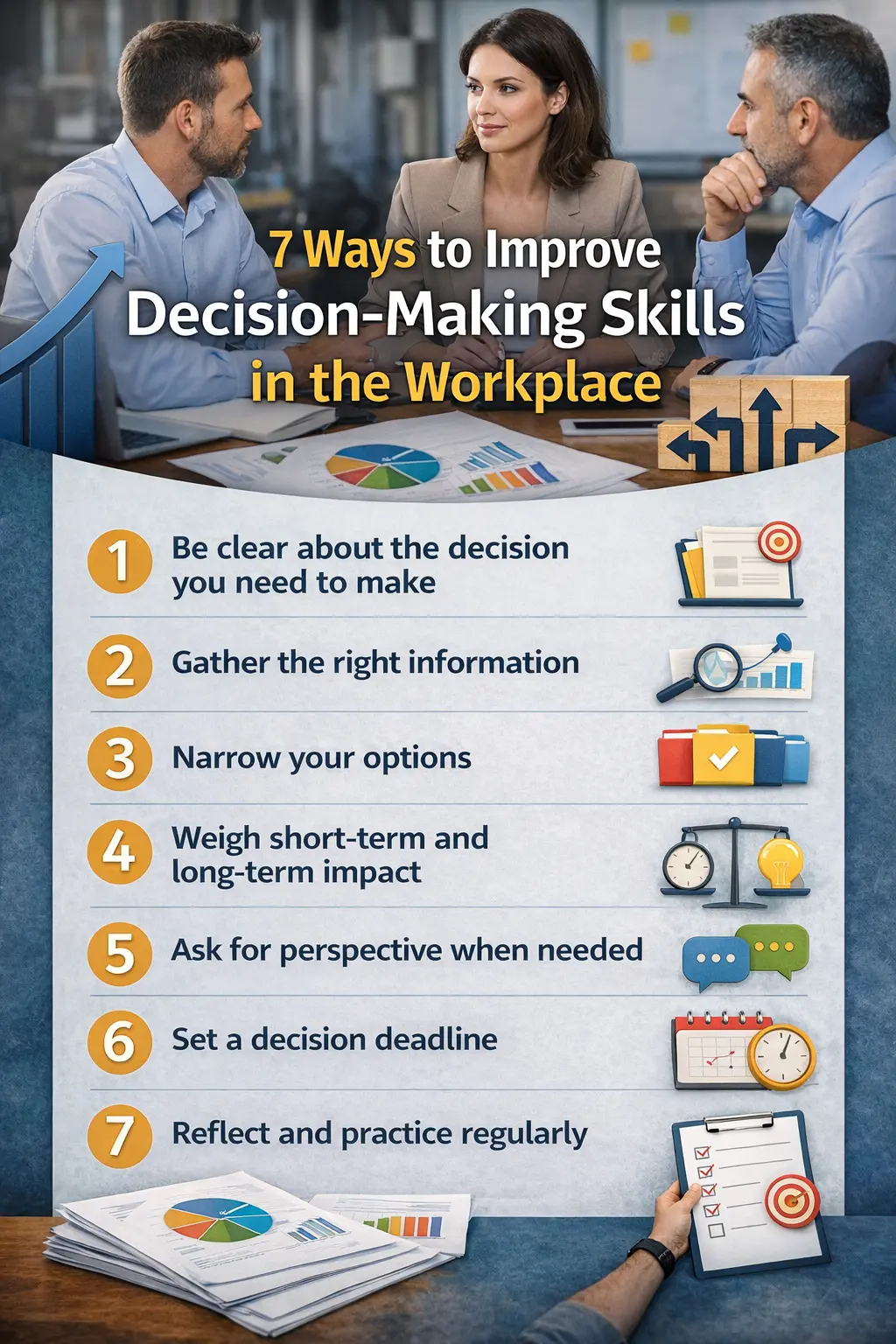
1. Be clear about the decision you need to make
Before you compare options, make sure you understand the real issue. A lot of poor workplace decisions happen because people respond to the wrong problem.
Take a moment to define what needs to be decided, why it matters, and what result you want. When the decision is clear, your next steps become much easier.
2. Gather the right information
Better decisions start with reliable information. That does not mean collecting every possible detail. It means focusing on the facts that will actually help you make a sound choice.
Look at the most relevant sources, such as recent data, previous results, team input, and any limits tied to time, budget, or resources. When your thinking is grounded in facts, your decision is more likely to hold up.
3. Narrow your options
Too many choices can slow you down. When every option seems possible, it becomes harder to move forward with confidence.
Instead of reviewing every idea, reduce your list to the two or three strongest options. This makes the decision easier to manage and helps you focus on quality over quantity.
4. Weigh short-term and long-term impact
Some decisions solve an immediate problem but create a bigger one later. That is why it helps to think beyond the moment.
Ask yourself:
- What will this choice solve right now?
- What problems could it create later?
- How will it affect the team, customers, or business goals?
Looking at both the immediate and future impact helps you make more balanced decisions.
5. Ask for perspective when needed
You do not need outside input for every choice, but some decisions benefit from another point of view. A colleague, manager, or subject expert may notice risks or opportunities you missed.
This is especially helpful when the stakes are high, the issue affects several people, or the situation is unclear. A quick conversation can give you more confidence in the direction you choose.
6. Set a decision deadline
Waiting too long can be just as harmful as deciding too quickly. A deadline keeps you from overthinking and helps you move from analysis to action.
For smaller decisions, you may only need a few minutes. For larger ones, you may need a day or two. What matters is giving yourself a reasonable time frame so the decision does not keep getting pushed aside.
7. Reflect and practice regularly
Decision-making improves with use. One of the best ways to get better is to review your choices after the fact and learn from them.
Think about questions like:
- What worked well?
- What did I miss?
- What would I change next time?
You can also build this skill through everyday work decisions, such as prioritizing tasks, handling client concerns, or choosing when to escalate an issue. Small choices help you build confidence for bigger ones.
Explore how this helps your business: leadership and management training
Common Decision-Making Mistakes to Avoid
Knowing what not to do can be just as useful as knowing what to do.
Overthinking every option
Not every decision deserves deep analysis. Save your longest review for high-impact choices.
Ignoring available data
Going with instinct alone can be risky when facts are easy to access.
Asking too many people
Input is valuable, but too much feedback can blur the path forward.
Letting fear delay action
Sometimes people avoid deciding because they fear being wrong. In reality, a thoughtful imperfect decision is often better than endless delay.
Failing to review results
If you never look back, you miss the chance to improve your judgment.
How Managers Can Help Teams Make Better Decisions
If you lead people, decision-making is not only a personal skill. It is a team skill.
Managers can improve workplace decisions by:
- setting clear priorities
- giving people the right level of authority
- defining who owns what
- encouraging thoughtful input
- creating a safe environment for questions
- reviewing outcomes without blame
Strong decision-making cultures do not happen by chance. They are built through clarity, trust, and accountability. When managers communicate well and support their teams, people feel more confident making decisions at the right level.
You can also strengthen team decision-making by documenting key choices, clarifying decision owners, and reviewing important outcomes together. These habits reduce confusion and help teams improve over time.
Frequently Asked Questions
How can you improve decision-making skills at work?
You can improve decision-making at work by defining the problem clearly, gathering relevant facts, setting decision criteria, and choosing a practical course of action. It also helps to review past decisions so you can learn what worked and what needs to change.
What are the best ways to improve your decision-making skills?
The best ways include strengthening critical thinking, managing emotions under pressure, asking the right people for input, and using a simple framework to compare options. Consistent practice with smaller daily choices also builds confidence over time.
Why is decision-making important in the workplace?
Decision-making is important because it affects productivity, teamwork, problem-solving, and business results. Poor decisions can create delays and confusion, while strong decisions help teams move faster and work with more clarity. Gallup’s workplace research connects engagement, trust, and manager effectiveness with stronger performance.
How do you make better decisions under pressure?
Start by slowing the moment down. Focus on the core issue, review the facts, and avoid reacting only from stress or fear. Harvard Business Review has highlighted how pressure can affect judgment, which is why simple decision frameworks are especially useful in high-stakes situations.
Can decision-making skills be developed?
Yes. Decision-making is a skill you can strengthen through practice, reflection, and better thinking habits. The more often you make clear, structured choices and review the outcome, the better your judgment becomes over time.
Conclusion
Improving your decision-making skills at work is not about having all the answers. It is about learning how to think clearly, evaluate options wisely, and take action with confidence. When you build better decision-making habits, you reduce hesitation, solve problems faster, and contribute more effectively to your team and organization.
The good news is that decision-making is a skill you can strengthen over time. By asking better questions, using the right information, and reflecting on outcomes, you can make smarter workplace choices that support both your professional growth and business success.
Want to build stronger leaders and better workplace performance? Explore our professional development training courses to help your teams improve decision-making, communication, and management skills for lasting business growth.