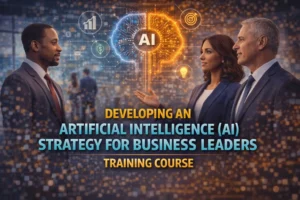

Developing an Artificial Intelligence (AI) Strategy for Business Leaders Training Course

Formats   Live Virtual: 4 hrs./1 Day  |  In-Person: 6 hrs./1 Day

Artificial intelligence is no longer experimental. It is becoming a core capability for mission delivery, operational efficiency, and public service innovation. However, successful AI adoption in business requires more than tools. It demands clear strategy, governance, and alignment with mission, policy, and public trust. This course equips business leaders and program managers with the frameworks, decision models, and practical steps needed to design, govern, and implement an AI strategy responsibly and effectively.

Learning Objectives

  • Define what an AI strategy means.
  • Align AI initiatives to mission, priorities, and mandates.
  • Identify high-value, low-risk AI use cases.
  • Navigate constraints (policy, procurement, security, compliance).
  • Establish AI governance, risk management, and ethical safeguards.
  • Build a phased, realistic AI roadmap.
  • Lead cross-functional adoption and change management.

Course Agenda »

Identifying Strategic AI Opportunities (Where AI Should be Applied)

  1. Linking AI to Organizational Mission
  2. Use Cases in Business
  3. Efficiency vs. Decision-Making Risk
  4. “Safe” Starting Points
  5. Avoiding High-Risk Early Deployments
  6. Prioritization Framework
  7. Common AI Use Cases

Human-AI Collaboration in Workflows (How AI Fits into Work)

  1. Redefining Work: Humans + AI
  2. Human-in-the-loop Systems
  3. Designing AI-Supported Workflows
  4. Building Trust and Adoption
  5. Case Studies: Business AI

Governance, Risk and Responsible AI

  1. Why Responsible AI is Non-Negotiable
  2. Core AI Risks
  3. AI Governance Framework
  4. Vendor and Tool Evaluation
  5. Monitoring and Lifecycle Management

Building and Executing an AI Roadmap

  1. Defining AI Vision Aligned to Mission
  2. AI Roadmap Development Framework
  3. Resource and Capability Planning
  4. Change Management and Adoption
  5. Measuring Success, ROE and ROI

GenAI and the Future

  1. Generative AI in Business Context
  2. Practical GenAI
  3. GenAI Prompting as a Workforce Skill
  4. Emerging Trends

Developing an Artificial Intelligence (AI) Strategy for Business Leaders Training Course

Formats   Live Virtual: 4 hrs./1 Day  |  In-Person: 6 hrs./1 Day

Artificial intelligence is no longer experimental. It is becoming a core capability for mission delivery, operational efficiency, and public service innovation. However, successful AI adoption in business requires more than tools. It demands clear strategy, governance, and alignment with mission, policy, and public trust. This course equips business leaders and program managers with the frameworks, decision models, and practical steps needed to design, govern, and implement an AI strategy responsibly and effectively.

Learning Objectives

  • Define what an AI strategy means.
  • Align AI initiatives to mission, priorities, and mandates.
  • Identify high-value, low-risk AI use cases.
  • Navigate constraints (policy, procurement, security, compliance).
  • Establish AI governance, risk management, and ethical safeguards.
  • Build a phased, realistic AI roadmap.
  • Lead cross-functional adoption and change management.

Course Agenda »

Identifying Strategic AI Opportunities (Where AI Should be Applied)

  1. Linking AI to Organizational Mission
  2. Use Cases in Business
  3. Efficiency vs. Decision-Making Risk
  4. “Safe” Starting Points
  5. Avoiding High-Risk Early Deployments
  6. Prioritization Framework
  7. Common AI Use Cases

Human-AI Collaboration in Workflows (How AI Fits into Work)

  1. Redefining Work: Humans + AI
  2. Human-in-the-loop Systems
  3. Designing AI-Supported Workflows
  4. Building Trust and Adoption
  5. Case Studies: Business AI

Governance, Risk and Responsible AI

  1. Why Responsible AI is Non-Negotiable
  2. Core AI Risks
  3. AI Governance Framework
  4. Vendor and Tool Evaluation
  5. Monitoring and Lifecycle Management

Building and Executing an AI Roadmap

  1. Defining AI Vision Aligned to Mission
  2. AI Roadmap Development Framework
  3. Resource and Capability Planning
  4. Change Management and Adoption
  5. Measuring Success, ROE and ROI

GenAI and the Future

  1. Generative AI in Business Context
  2. Practical GenAI
  3. GenAI Prompting as a Workforce Skill
  4. Emerging Trends