How to Improve Communication Skills in the Workplace​?

Jason Hicks

Jason Hicks

Owner at PTR Training

How to Improve Communication Skills in the Workplace

Workplace communication has become more complex than ever. With hybrid teams, cross-functional collaboration, and faster decision-making, the ability to communicate clearly and effectively is now a core professional skill—not just a soft skill.

Miscommunication is one of the most common and costly challenges organizations face. It leads to errors, delays, conflict, and disengagement. In contrast, organizations that prioritize effective communication build stronger teams, make better decisions, and foster healthier work cultures.

Strong workplace communication skills shape how teams collaborate, how leaders lead, and how organizations perform. When communication breaks down, productivity suffers, engagement declines, and misunderstandings increase. When communication is clear and consistent, teams operate with alignment, confidence, and trust.

In this guide, we explore why communication skills are so important in the workplace, the real challenges teams face today, and clear, actionable insights on how to improve communication skills in the workplace—from everyday interactions to leadership communication.

Why Communication Skills Are Important in the Workplace?

Workplace communication goes far beyond exchanging information. It shapes relationships, builds trust, and determines how effectively people work together.

According to the Society for Human Resource Management (SHRM), ineffective communication is one of the leading contributors to workplace stress, low morale, and missed performance goals. Poor communication doesn’t just slow work—it creates confusion, frustration, and disengagement.

Strong communication skills help organizations:

  • Reduce misunderstandings and rework
  • Improve collaboration and teamwork
  • Increase employee engagement and morale
  • Strengthen leadership credibility
  • Enhance customer satisfaction

Gallup research consistently shows that employees who feel heard and understood are more engaged at work. Engagement, in turn, is closely linked to higher performance, lower turnover, and better business outcomes.

In short, communication skills are important in the workplace because they influence nearly every aspect of organizational effectiveness.

What Are Workplace Communication Skills?

Workplace communication skills refer to the ability to convey information, ideas, and emotions clearly and professionally in a work setting. These skills include both verbal and non-verbal communication and apply across multiple channels, including meetings, emails, presentations, and digital platforms.

Key components of workplace communication skills include:

  • Active listening
  • Clear verbal communication
  • Professional written communication
  • Non-verbal awareness
  • Emotional intelligence
  • Feedback and conflict management

Strong communication is not about speaking more—it’s about communicating with purpose and clarity.

Common Communication Challenges in the Workplace

Despite its importance, communication is one of the most common workplace challenges. Many issues arise not from lack of effort, but from lack of alignment and clarity.

In fast-moving work environments, messages are often rushed, assumptions are made, and context is missing. Remote and hybrid work can further magnify misunderstandings when tone, intent, and non-verbal cues are lost.

According to McKinsey, employees spend nearly 20% of their workweek searching for information or clarifying communication, highlighting how communication gaps directly impact productivity.

10 Ways to Improve Workplace Communication Skills

Improving communication is a continuous process that requires awareness, practice, and feedback. The strategies below are widely recommended by leadership experts, HR professionals, and workplace communication trainers.
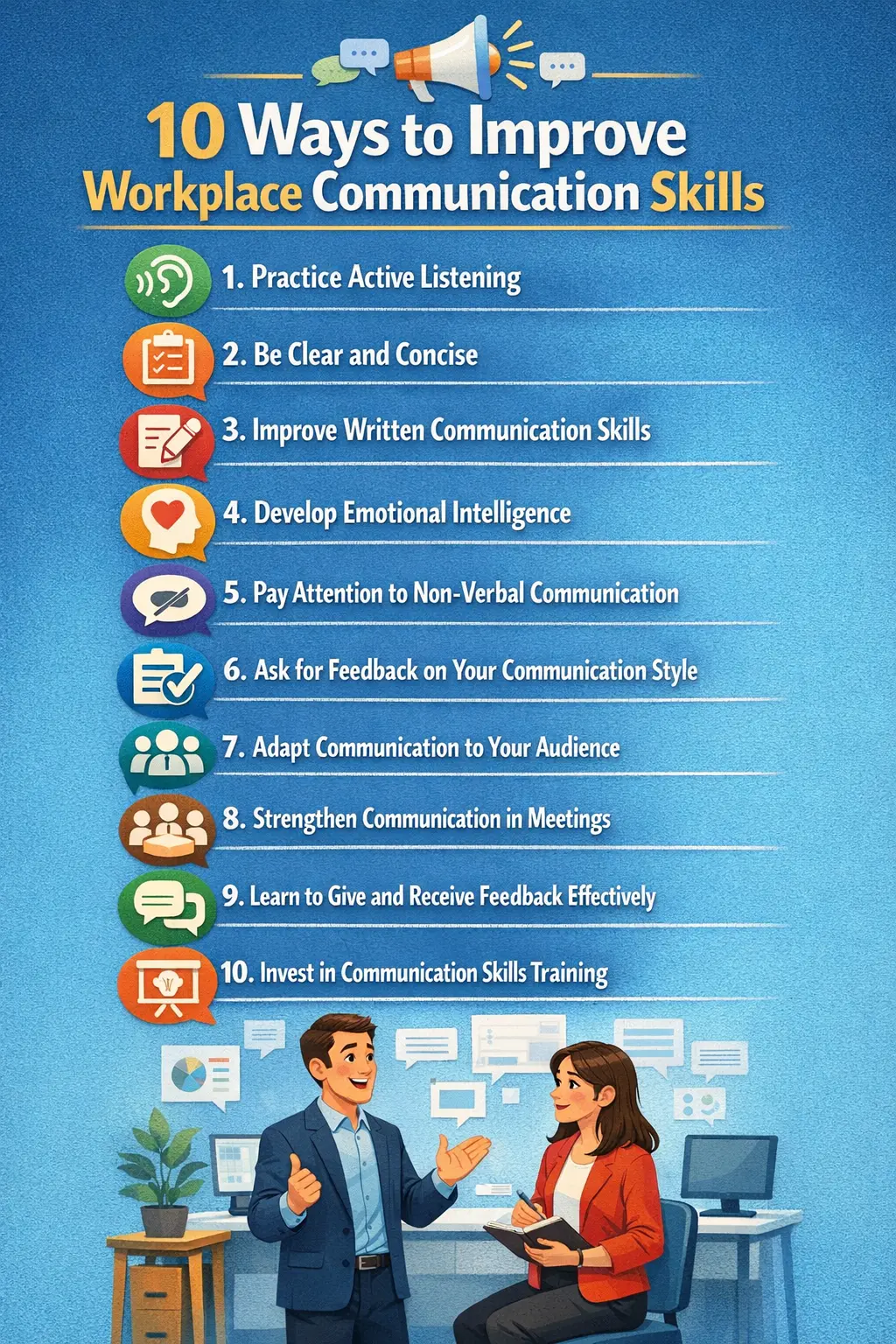
10 Ways to Improve Workplace Communication Skills

1. Practice Active Listening

One of the most overlooked workplace communication skills is listening. Many people listen to respond rather than to understand, which often leads to misunderstandings.

Active listening means giving your full attention to the speaker, avoiding interruptions, asking thoughtful clarifying questions, and reflecting back what you’ve heard to confirm understanding. When employees feel genuinely heard, trust improves and collaboration becomes more effective. Research highlighted by Harvard Business Review shows that feeling listened to increases employee engagement and idea-sharing.

2. Be Clear and Concise

Clarity is the foundation of effective communication. When messages are vague or overloaded with unnecessary information, confusion and frustration follow.

Clear communicators use simple, direct language, avoid jargon when possible, focus on key points, and confirm understanding when stakes are high. Whether in meetings or emails, clarity saves time, reduces errors, and minimizes follow-up confusion.

3. Improve Written Communication Skills

Written communication plays a major role in modern workplaces, especially with email, messaging platforms, and documentation. Poorly written messages can slow decisions and create unnecessary back-and-forth.

Strong written communication involves organizing information logically, maintaining a professional tone, using clear subject lines, and paying attention to grammar and formatting. Grammarly’s workplace research shows that professionals spend a significant portion of their day reading and writing, making strong writing skills essential for efficiency and professionalism.

4. Develop Emotional Intelligence

Emotional intelligence (EQ) directly impacts how people communicate, especially during stress, conflict, or change. Individuals with strong EQ recognize emotional cues, manage their reactions, and respond thoughtfully rather than impulsively.

In the workplace, emotional intelligence improves communication by supporting empathy, adaptability, and constructive dialogue. Leaders with high EQ tend to communicate more effectively during uncertainty, helping teams stay focused and confident.

5. Pay Attention to Non-Verbal Communication

Communication isn’t just about words. Non-verbal cues such as body language, facial expressions, and tone often carry more meaning than spoken language.

Maintaining appropriate eye contact, using open posture, and aligning tone with intent help ensure messages are received as intended. Even in virtual meetings, tone of voice and facial expressions play a critical role in how communication is interpreted.

6. Ask for Feedback on Your Communication Style

One of the most effective ways to improve communication skills in the workplace is by asking for feedback. Others often notice patterns or issues that we may overlook ourselves.

Constructive feedback can reveal unclear messaging, tone concerns, listening gaps, or missed opportunities to engage. Seeking feedback demonstrates self-awareness and a commitment to growth—qualities strongly associated with effective leadership and strong professional relationships.

7. Adapt Communication to Your Audience

Not all audiences communicate the same way. Effective communicators adjust their tone, level of detail, and delivery style depending on whether they are speaking to peers, leaders, clients, or cross-functional teams.

Audience-aware communication also considers cultural and generational differences, context, and expectations. This adaptability often distinguishes highly effective communicators from average ones.

8. Strengthen Communication in Meetings

Meetings are one of the most common—and often most frustrating—workplace communication environments. Poorly run meetings waste time and reduce engagement.

Clear meeting communication includes setting agendas in advance, encouraging participation, summarizing key points, and clearly defining next steps. Microsoft’s Work Trend Index identifies ineffective meetings as a major productivity concern, reinforcing the importance of clear communication in group settings.

9. Learn to Give and Receive Feedback Effectively

Feedback is essential for growth, but it must be communicated thoughtfully. Poorly delivered feedback can lead to defensiveness, while well-structured feedback builds trust and improvement.

Effective feedback focuses on specific behaviors, is timely, balances positive and constructive input, and encourages dialogue. Strong feedback skills support continuous learning and healthier workplace relationships.

10. Invest in Communication Skills Training

While experience helps, structured training accelerates communication skill development. Professional training provides frameworks, guided practice, and real-time feedback that are difficult to gain through experience alone.

Organizations that invest in communication skills training courses often see measurable improvements in engagement, collaboration, and leadership effectiveness. For individuals, training builds confidence and consistency in high-stakes conversations.

The Role of Leaders in Workplace Communication

Leaders set the tone for communication across the organization. Their behavior sets the standard for how information flows, how openly people speak, and how feedback is handled.

According to Gallup, managers account for up to 70% of the variance in employee engagement, much of which is influenced by communication quality. Leaders who communicate clearly, listen actively, and provide consistent direction create environments where employees feel informed and valued.

Effective leaders communicate expectations, explain the “why” behind decisions, and encourage two-way dialogue. When leaders model strong communication, it strengthens trust and alignment across the organization.

Long-Term Benefits of Strong Workplace Communication Skills

Organizations that prioritize communication don’t just see short-term improvements—they build long-term resilience.

Strong communication skills contribute to:

  • Higher employee engagement and retention
  • Faster decision-making
  • Reduced conflict and misunderstandings
  • Stronger organizational culture
  • Better customer and stakeholder relationships

According to Deloitte, organizations that invest in leadership and capability development—including communication—are 2.4 times more likely to meet performance targets, reinforcing the strategic value of communication-focused development.

Long-Term Benefits of Strong Workplace Communication Skills

Organizations that prioritize communication don’t just see short-term improvements—they build long-term resilience.

Strong communication skills contribute to:

  • Higher employee engagement and retention
  • Faster decision-making
  • Reduced conflict and misunderstandings
  • Stronger organizational culture
  • Better customer and stakeholder relationships

According to Deloitte, organizations that invest in leadership and capability development—including communication—are 2.4 times more likely to meet performance targets, reinforcing the strategic value of communication-focused development.

Conclusion

Workplace communication skills are among the most valuable capabilities professionals can develop. In an environment defined by change, collaboration, and complexity, the ability to communicate clearly and effectively is a competitive advantage.

By focusing on clarity, listening, emotional intelligence, and continuous improvement, individuals can significantly improve how they communicate at work. For organizations, strengthening communication skills supports engagement, performance, and long-term success.

Strengthen Communication Where It Matters Most

Reading about communication is the first step—applying it is where real impact begins.

If you’re ready to improve workplace communication, strengthen leadership effectiveness, and build confident, collaborative teams, structured communication and leadership training can help.

Contact PTR Training to learn more about professional communication and leadership and management training courses designed to build practical, real-world skills for today’s workplace.

Frequently Asked Questions

1. What are the most common workplace communication challenges?

Common challenges include unclear expectations, poor listening habits, misinterpretation of tone in written messages, lack of feedback, and communication gaps in remote or hybrid teams. Addressing these issues requires clarity, emotional intelligence, and consistent communication practices.

2. How can employees improve communication skills at work?

Employees can improve communication by practicing active listening, seeking feedback, improving written communication, and adapting messages to their audience.

3. How does leadership communication affect employees?

Leadership communication shapes trust, clarity, and engagement. Clear and consistent communication from leaders helps employees feel informed, supported, and aligned with goals.

4. Can communication training really improve performance?

Yes. Structured communication training helps individuals develop practical skills that improve collaboration, reduce conflict, and increase confidence in workplace interactions.

5. How does poor communication affect workplace productivity?

Poor communication can lead to errors, missed deadlines, duplicated work, and increased conflict. Over time, it reduces efficiency, damages morale, and increases employee frustration and disengagement.

Jason Hicks

Jason Hicks

Owner at PTR Training

LinkedIn

As Owner of PTR Training, Jason Hicks leads the company’s strategic direction and oversees the development of performance-based training solutions for organizations and professionals. With a background grounded in both education and applied practice, Jason combines formal training in human performance and leadership with extensive real-world experience designing, delivering, and scaling training programs. He is known for translating complex performance concepts into practical, results-driven solutions that improve individual capability and organizational outcomes.

You May Also Like

Communication SkillsWorkplace Wellness
How to Improve Communication Skills in the Workplace

How to Improve Communication Skills in the Workplace​?

How to Improve Communication Skills in the Workplace

Workplace communication has become more complex than ever. With hybrid teams, cross-functional collaboration, and faster decision-making, the ability to communicate clearly and effectively is now a core professional skill—not just a soft skill.

Miscommunication is one of the most common and costly challenges organizations face. It leads to errors, delays, conflict, and disengagement. In contrast, organizations that prioritize effective communication build stronger teams, make better decisions, and foster healthier work cultures.

Strong workplace communication skills shape how teams collaborate, how leaders lead, and how organizations perform. When communication breaks down, productivity suffers, engagement declines, and misunderstandings increase. When communication is clear and consistent, teams operate with alignment, confidence, and trust.

In this guide, we explore why communication skills are so important in the workplace, the real challenges teams face today, and clear, actionable insights on how to improve communication skills in the workplace—from everyday interactions to leadership communication.

Why Communication Skills Are Important in the Workplace?

Workplace communication goes far beyond exchanging information. It shapes relationships, builds trust, and determines how effectively people work together.

According to the Society for Human Resource Management (SHRM), ineffective communication is one of the leading contributors to workplace stress, low morale, and missed performance goals. Poor communication doesn’t just slow work—it creates confusion, frustration, and disengagement.

Strong communication skills help organizations:

  • Reduce misunderstandings and rework
  • Improve collaboration and teamwork
  • Increase employee engagement and morale
  • Strengthen leadership credibility
  • Enhance customer satisfaction

Gallup research consistently shows that employees who feel heard and understood are more engaged at work. Engagement, in turn, is closely linked to higher performance, lower turnover, and better business outcomes.

In short, communication skills are important in the workplace because they influence nearly every aspect of organizational effectiveness.

What Are Workplace Communication Skills?

Workplace communication skills refer to the ability to convey information, ideas, and emotions clearly and professionally in a work setting. These skills include both verbal and non-verbal communication and apply across multiple channels, including meetings, emails, presentations, and digital platforms.

Key components of workplace communication skills include:

  • Active listening
  • Clear verbal communication
  • Professional written communication
  • Non-verbal awareness
  • Emotional intelligence
  • Feedback and conflict management

Strong communication is not about speaking more—it’s about communicating with purpose and clarity.

Common Communication Challenges in the Workplace

Despite its importance, communication is one of the most common workplace challenges. Many issues arise not from lack of effort, but from lack of alignment and clarity.

In fast-moving work environments, messages are often rushed, assumptions are made, and context is missing. Remote and hybrid work can further magnify misunderstandings when tone, intent, and non-verbal cues are lost.

According to McKinsey, employees spend nearly 20% of their workweek searching for information or clarifying communication, highlighting how communication gaps directly impact productivity.

10 Ways to Improve Workplace Communication Skills

Improving communication is a continuous process that requires awareness, practice, and feedback. The strategies below are widely recommended by leadership experts, HR professionals, and workplace communication trainers.

10 Ways to Improve Workplace Communication Skills

1. Practice Active Listening

One of the most overlooked workplace communication skills is listening. Many people listen to respond rather than to understand, which often leads to misunderstandings.

Active listening means giving your full attention to the speaker, avoiding interruptions, asking thoughtful clarifying questions, and reflecting back what you’ve heard to confirm understanding. When employees feel genuinely heard, trust improves and collaboration becomes more effective. Research highlighted by Harvard Business Review shows that feeling listened to increases employee engagement and idea-sharing.

2. Be Clear and Concise

Clarity is the foundation of effective communication. When messages are vague or overloaded with unnecessary information, confusion and frustration follow.

Clear communicators use simple, direct language, avoid jargon when possible, focus on key points, and confirm understanding when stakes are high. Whether in meetings or emails, clarity saves time, reduces errors, and minimizes follow-up confusion.

3. Improve Written Communication Skills

Written communication plays a major role in modern workplaces, especially with email, messaging platforms, and documentation. Poorly written messages can slow decisions and create unnecessary back-and-forth.

Strong written communication involves organizing information logically, maintaining a professional tone, using clear subject lines, and paying attention to grammar and formatting. Grammarly’s workplace research shows that professionals spend a significant portion of their day reading and writing, making strong writing skills essential for efficiency and professionalism.

4. Develop Emotional Intelligence

Emotional intelligence (EQ) directly impacts how people communicate, especially during stress, conflict, or change. Individuals with strong EQ recognize emotional cues, manage their reactions, and respond thoughtfully rather than impulsively.

In the workplace, emotional intelligence improves communication by supporting empathy, adaptability, and constructive dialogue. Leaders with high EQ tend to communicate more effectively during uncertainty, helping teams stay focused and confident.

5. Pay Attention to Non-Verbal Communication

Communication isn’t just about words. Non-verbal cues such as body language, facial expressions, and tone often carry more meaning than spoken language.

Maintaining appropriate eye contact, using open posture, and aligning tone with intent help ensure messages are received as intended. Even in virtual meetings, tone of voice and facial expressions play a critical role in how communication is interpreted.

6. Ask for Feedback on Your Communication Style

One of the most effective ways to improve communication skills in the workplace is by asking for feedback. Others often notice patterns or issues that we may overlook ourselves.

Constructive feedback can reveal unclear messaging, tone concerns, listening gaps, or missed opportunities to engage. Seeking feedback demonstrates self-awareness and a commitment to growth—qualities strongly associated with effective leadership and strong professional relationships.

7. Adapt Communication to Your Audience

Not all audiences communicate the same way. Effective communicators adjust their tone, level of detail, and delivery style depending on whether they are speaking to peers, leaders, clients, or cross-functional teams.

Audience-aware communication also considers cultural and generational differences, context, and expectations. This adaptability often distinguishes highly effective communicators from average ones.

8. Strengthen Communication in Meetings

Meetings are one of the most common—and often most frustrating—workplace communication environments. Poorly run meetings waste time and reduce engagement.

Clear meeting communication includes setting agendas in advance, encouraging participation, summarizing key points, and clearly defining next steps. Microsoft’s Work Trend Index identifies ineffective meetings as a major productivity concern, reinforcing the importance of clear communication in group settings.

9. Learn to Give and Receive Feedback Effectively

Feedback is essential for growth, but it must be communicated thoughtfully. Poorly delivered feedback can lead to defensiveness, while well-structured feedback builds trust and improvement.

Effective feedback focuses on specific behaviors, is timely, balances positive and constructive input, and encourages dialogue. Strong feedback skills support continuous learning and healthier workplace relationships.

10. Invest in Communication Skills Training

While experience helps, structured training accelerates communication skill development. Professional training provides frameworks, guided practice, and real-time feedback that are difficult to gain through experience alone.

Organizations that invest in communication skills training courses often see measurable improvements in engagement, collaboration, and leadership effectiveness. For individuals, training builds confidence and consistency in high-stakes conversations.

The Role of Leaders in Workplace Communication

Leaders set the tone for communication across the organization. Their behavior sets the standard for how information flows, how openly people speak, and how feedback is handled.

According to Gallup, managers account for up to 70% of the variance in employee engagement, much of which is influenced by communication quality. Leaders who communicate clearly, listen actively, and provide consistent direction create environments where employees feel informed and valued.

Effective leaders communicate expectations, explain the “why” behind decisions, and encourage two-way dialogue. When leaders model strong communication, it strengthens trust and alignment across the organization.

Long-Term Benefits of Strong Workplace Communication Skills

Organizations that prioritize communication don’t just see short-term improvements—they build long-term resilience.

Strong communication skills contribute to:

  • Higher employee engagement and retention
  • Faster decision-making
  • Reduced conflict and misunderstandings
  • Stronger organizational culture
  • Better customer and stakeholder relationships

According to Deloitte, organizations that invest in leadership and capability development—including communication—are 2.4 times more likely to meet performance targets, reinforcing the strategic value of communication-focused development.

Long-Term Benefits of Strong Workplace Communication Skills

Organizations that prioritize communication don’t just see short-term improvements—they build long-term resilience.

Strong communication skills contribute to:

  • Higher employee engagement and retention
  • Faster decision-making
  • Reduced conflict and misunderstandings
  • Stronger organizational culture
  • Better customer and stakeholder relationships

According to Deloitte, organizations that invest in leadership and capability development—including communication—are 2.4 times more likely to meet performance targets, reinforcing the strategic value of communication-focused development.

Conclusion

Workplace communication skills are among the most valuable capabilities professionals can develop. In an environment defined by change, collaboration, and complexity, the ability to communicate clearly and effectively is a competitive advantage.

By focusing on clarity, listening, emotional intelligence, and continuous improvement, individuals can significantly improve how they communicate at work. For organizations, strengthening communication skills supports engagement, performance, and long-term success.

Strengthen Communication Where It Matters Most

Reading about communication is the first step—applying it is where real impact begins.

If you’re ready to improve workplace communication, strengthen leadership effectiveness, and build confident, collaborative teams, structured communication and leadership training can help.

Contact PTR Training to learn more about professional communication and leadership and management training courses designed to build practical, real-world skills for today’s workplace.

Frequently Asked Questions

1. What are the most common workplace communication challenges?

Common challenges include unclear expectations, poor listening habits, misinterpretation of tone in written messages, lack of feedback, and communication gaps in remote or hybrid teams. Addressing these issues requires clarity, emotional intelligence, and consistent communication practices.

2. How can employees improve communication skills at work?

Employees can improve communication by practicing active listening, seeking feedback, improving written communication, and adapting messages to their audience.

3. How does leadership communication affect employees?

Leadership communication shapes trust, clarity, and engagement. Clear and consistent communication from leaders helps employees feel informed, supported, and aligned with goals.

4. Can communication training really improve performance?

Yes. Structured communication training helps individuals develop practical skills that improve collaboration, reduce conflict, and increase confidence in workplace interactions.

5. How does poor communication affect workplace productivity?

Poor communication can lead to errors, missed deadlines, duplicated work, and increased conflict. Over time, it reduces efficiency, damages morale, and increases employee frustration and disengagement.