
As project management evolves lightning, staying up-to-date with the latest trends and techniques is essential for success.
Project management is no longer just about timelines, task lists, and status meetings. It has become a strategic engine that determines whether organisations can survive — or lead — in an increasingly volatile, tech-driven world. As new project management trends emerge at unprecedented speed, from AI-powered automation to hybrid workforces scattered across continents, the rules of project leadership are being rewritten faster than ever before.
Today’s project managers are expected to do more than deliver projects. They must anticipate disruption, adapt methodologies on the fly, and make decisions backed by data, intelligence, and human insight. The modern PM is part strategist, part technologist, part coach — and entirely indispensable.
As industries embrace autonomous tools, digital ecosystems, ESG commitments, and hyper-collaboration, one thing is clear:
The future of project management will not reward those who follow the old playbook — it will elevate those who evolve with the new one.
Whether you're stepping into project management for the first time or leading multi-million-dollar transformations, understanding the latest trends isn’t optional.
It’s the difference between maintaining relevance and leading with impact in a landscape that changes every quarter, not every decade.
So let’s dive into the 10 emerging project management trends that are reshaping how teams plan, execute, innovate, and succeed — now and in the years ahead.
10 Latest Trends in Project Management
Here are the most important current and future project management trends shaping the landscape:
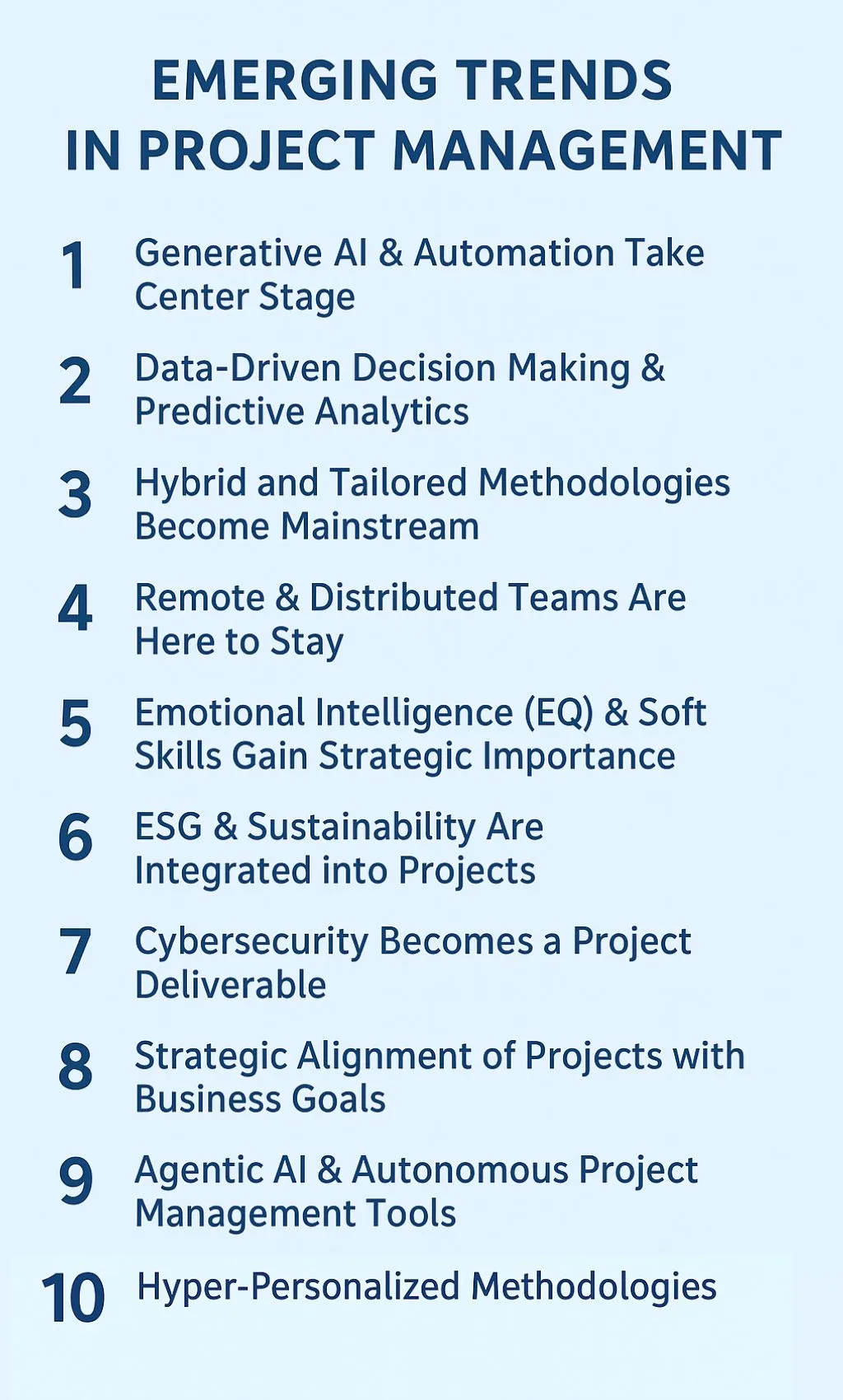
1. Generative AI & Automation Take Center Stage
The rapid rise of intelligent automation is redefining how projects are planned and executed. According to Coursera, more than half of project managers now use generative tools in some part of their work.
These systems go far beyond task automation — they support predictive risk analysis, capacity planning, and intelligent recommendations that help PMs work faster and more accurately.
Why it matters: Leveraging these smart project systems frees teams from repetitive work and enables managers to focus on strategy and value-driven decision-making.
“PMI reports that 81% of project professionals say their organisation is already being influenced by AI-driven technologies. Gartner estimates that by 2030, nearly 80% of routine PM tasks may be fully automated through intelligent systems.”
2. Data-Driven Decision Making & Predictive Analytics
Modern project management increasingly relies on predictive engines that can forecast risks and opportunities long before they surface. Real-time dashboards, KPI tracking, and embedded analytics help PMs make stronger, evidence-backed decisions.
Why it matters: Projects become more predictable, transparent, and efficient when decision-making is powered by data rather than guesswork.
PMI’s “Shaping the Future of PM with AI” report states that 82% of senior leaders expect smart analytics to reshape how projects are executed.
3. Hybrid and Tailored Methodologies Become Mainstream
Rigid, one-size-fits-all methodologies are giving way to hybrid approaches combining Agile, Waterfall, and other frameworks.
- According to KnowledgeHut, hybrid project management lets teams pick and combine methods depending on project needs.
- AAPM highlights that this flexibility is now widespread across industries, not just in IT.
- Manning Global predicts a rise in squad-based teams — small, cross-functional units that reduce bureaucracy and improve agility.
Why it matters: Hybrid methods give organizations the adaptability they need to respond to changing requirements while retaining structure where it's needed.
4. Remote & Distributed Teams Are Here to Stay
Remote and hybrid work models are no longer trends; they’re the new normal.
- Remote work is continuing to influence how projects are managed, highlighting the importance of asynchronous communication, emotional intelligence, and digital collaboration tools.
- Advanced project management tools are now built for globally distributed teams, with real-time collaboration and mobile access.
Why it matters: Project managers need to master remote leadership, digital collaboration, and cross-time-zone coordination in order to maintain productivity and engagement in distributed teams.
5. Emotional Intelligence (EQ) & Soft Skills Gain Strategic Importance
As technology evolves, soft skills are becoming more critical — particularly emotional intelligence.
- The Knowledge Academy cites that EQ is driving better team collaboration, conflict resolution, and empathy in leadership.
- The Digital Project Manager highlights that “power skills” like empathy, communication, and adaptability are now core skills for PMs.
- According to LinkedIn’s analysis of project management trends, AI literacy is important — but so is the ability to lead, mentor, and inspire: PMs need more emotional intelligence than ever.
Why it matters: Projects aren’t just technical — they’re human. The ability to empathize, motivate, and inspire separates average PMs from great leaders.
6. ESG & Sustainability Are Integrated into Projects
Sustainability and ESG (Environmental, Social, Governance) practices are no longer peripheral concerns — they’re core project goals.
- According to AAPM, there is a growing expectation that project managers incorporate ESG metrics into project planning and delivery.
- Inspire London College forecasts that by 2026, ESG accountability will be baked into project outcomes, including carbon footprints, ethical supply chains, and social impact.
Why it matters: Projects increasingly serve not just business objectives, but societal goals — aligning with stakeholder values and global sustainability commitments.
7. Cybersecurity Becomes a Project Deliverable
As more projects become digital-first, cybersecurity is no longer just an IT checklist — it's a core project management concern.
- The Knowledge Academy predicts that in 2026, project managers will need to proactively embed security protocols (like encryption, access control) into every phase of a project.
- With distributed teams and cloud-based tools, the attack surface for data risks is wider, making security planning indispensable.
Why it matters: Protecting sensitive data, maintaining stakeholder trust, and managing risk are now key responsibilities of project management.
8. Strategic Alignment of Projects with Business Goals
Project management is no longer isolated from business strategy — it's becoming deeply integrated.
- According to The Knowledge Academy, more companies are aligning project portfolios with long-term organizational strategies, not just short-term deliverables.
- This alignment helps project teams understand why their work matters, and how it contributes to larger business outcomes.
Why it matters: Projects become drivers of value, not just tasks to be completed — increasing ROI, accountability, and strategic clarity.
9. Agentic AI & Autonomous Project Management Tools
Project tools are evolving from assistants to autonomous partners. These next-generation systems will:
- Assess resource constraints in real time
- Predict delays automatically
- Suggest corrective actions
- Continuously learn from past project behaviour
- Optimise schedules without manual input
Instead of simply providing insights, these agentic systems will act — enabling PMs to oversee strategy while machines handle operational complexity.
10. Hyper-Personalized Methodologies
Hyper-personalized project methodologies are rapidly emerging as teams move away from rigid, one-size-fits-all frameworks. Instead of following a single model, project teams now customize their approach at a micro-level — adapting methods based on:
- project complexity
- team maturity
- risk appetite
- stakeholder expectations
This shift enables organizations to operate with more precision, agility, and efficiency, ultimately improving project outcomes.
Implications for Leaders and Project Managers
- Upskill Strategically: PMs should invest in AI literacy, data analytics, and emotional intelligence training to stay relevant.
- Adopt Flexible Methodologies: Encourage teams to experiment with hybrid, tailored project frameworks rather than rigidly sticking to one methodology.
- Embed ESG and Ethics: Make sustainability and ethical decision-making part of every project’s success criteria.
- Prioritize Security: Work with IT and security teams early to build risk mitigation and data protection into project plans.
- Foster Resilience: Prepare for uncertainty by building contingency plans, upskilling teams, and promoting adaptive leadership.
As AI transforms project workflows, only 18% of project managers currently report having good practical experience with AI tools. That gap underscores why AI literacy, combined with human “power skills” like empathy and strategic thinking, is now a top priority for PM professionals.
How PTR Can Help You Navigate These Trends?
At PTR, we understand that today's project management trends require more than just technical knowledge — they demand a strategic, future-oriented mindset. That’s why our Project Management Courses are designed to help professionals upskill in the exact areas shaping the future of the industry. Our training programs cover:
- AI & automation integration for project managers
- Data-driven decision-making and analytics
- Leadership and emotional intelligence development
- Methods blending Agile, Waterfall, and hybrid approaches
- ESG-aligned project planning and risk management
Whether you're elevating your skills for today’s expectations or preparing for the future, PTR’s training programs help you lead with confidence, resilience, and innovation.
Final Thoughts
The latest trends in project management aren’t just incremental — they’re transformational. From AI and data analytics to sustainability, emotional intelligence, and resilience, the PM landscape is evolving rapidly. Leaders and project managers who lean into these emerging trends in project management will not only deliver better projects — they'll shape the future.
To stay ahead, it’s time to rethink how you manage, lead, and deliver. The future favors the adaptive, the strategic, and the brave.
FAQs
1. What are the latest trends in project management?
The latest trends in project management include the rise of AI and automation, data-driven decision making, hybrid methodologies, remote collaboration, emotional intelligence, ESG integration, cybersecurity, strategic alignment, autonomous AI tools, and hyper-personalized methodologies. These trends are reshaping how teams plan, execute, and deliver projects across industries.
2. Why are project management trends important to follow?
Following project management trends helps organizations stay competitive, improve efficiency, adopt better tools, and future-proof their processes. It also ensures teams develop the skills and capabilities needed to handle evolving business challenges and technological changes.
3. How is AI affecting project management today?
AI is transforming project management by automating routine tasks, improving risk prediction, optimizing scheduling, enhancing reporting, and enabling smarter decision-making. AI-powered tools are acting as co-pilots that support project managers with analytics, insights, and automation.
4. What skills do project managers need to stay relevant in the future?
Future-ready project managers need strong skills in AI literacy, data analytics, leadership, emotional intelligence (EQ), risk management, remote team coordination, and hybrid methodology implementation. These power skills are becoming just as critical as technical PM knowledge.
5. Are hybrid project management methodologies better than traditional ones?
Hybrid methodologies aren’t “better” — but they are more flexible. They allow teams to combine Agile, Waterfall, and other frameworks based on project needs. This approach improves adaptability, reduces bottlenecks, and supports more efficient project delivery in dynamic environments.
6. How will sustainability and ESG impact future project management?
Sustainability and ESG will become core project metrics, not optional add-ons. Projects will be evaluated on environmental impact, social responsibility, ethical supply chains, and governance standards. This shift aligns project outcomes with stakeholder expectations and global sustainability goals.
7. Why is emotional intelligence so important for project managers?
Emotional intelligence helps project managers communicate effectively, resolve conflicts, motivate teams, and build trust — especially in remote or hybrid environments. As technology handles more technical tasks, EQ becomes a key differentiator for successful leadership.
8. What role will cybersecurity play in project management?
Cybersecurity is becoming a project requirement. With remote teams and cloud-based tools growing, project managers must integrate data protection, access control, and security protocols into every phase of project planning and execution.
9. How can organizations prepare for the future of project management?
Organizations should invest in AI-powered tools, upskill teams in analytics and soft skills, adopt flexible methodologies, strengthen cybersecurity practices, and align projects closely with strategic business objectives. Continuous learning is essential to stay competitive.
10. Where can professionals learn the skills required for emerging project management trends?
Professionals can enroll in specialized project management training programs that cover AI, analytics, hybrid methodologies, leadership, and ESG practices. PTR’s Project Management Courses offer structured learning paths designed to prepare managers for the future of work.