
Introduction
Every organization wants high-performing employees. Yet many leaders quietly struggle with inconsistent productivity, disengagement, missed deadlines, or underwhelming results.
If you’re wondering how to improve employee performance at work, the answer isn’t found in pressure or micromanagement. Performance improves when clarity, accountability, skill development, and leadership alignment work together.
Whether you manage a small team or lead an entire organization, understanding the fundamentals of improving employee performance can transform both culture and results.
Why Employee Performance Matters More Than Ever
Employee performance directly impacts revenue, retention, and customer satisfaction. According to Gallup’s employee engagement research, highly engaged teams show 23% higher profitability compared to disengaged teams.
Performance isn’t just about working harder. It’s about working smarter, staying aligned, and feeling motivated.
When you focus on improving employee performance, you:
- Reduce costly turnover
- Increase output quality
- Strengthen team morale
- Improve customer experience
- Drive long-term growth
If your organization is scaling or navigating change, performance management becomes even more critical.
7 Proven Employee Performance Improvement Strategies
Below are practical, research-backed strategies you can implement immediately.
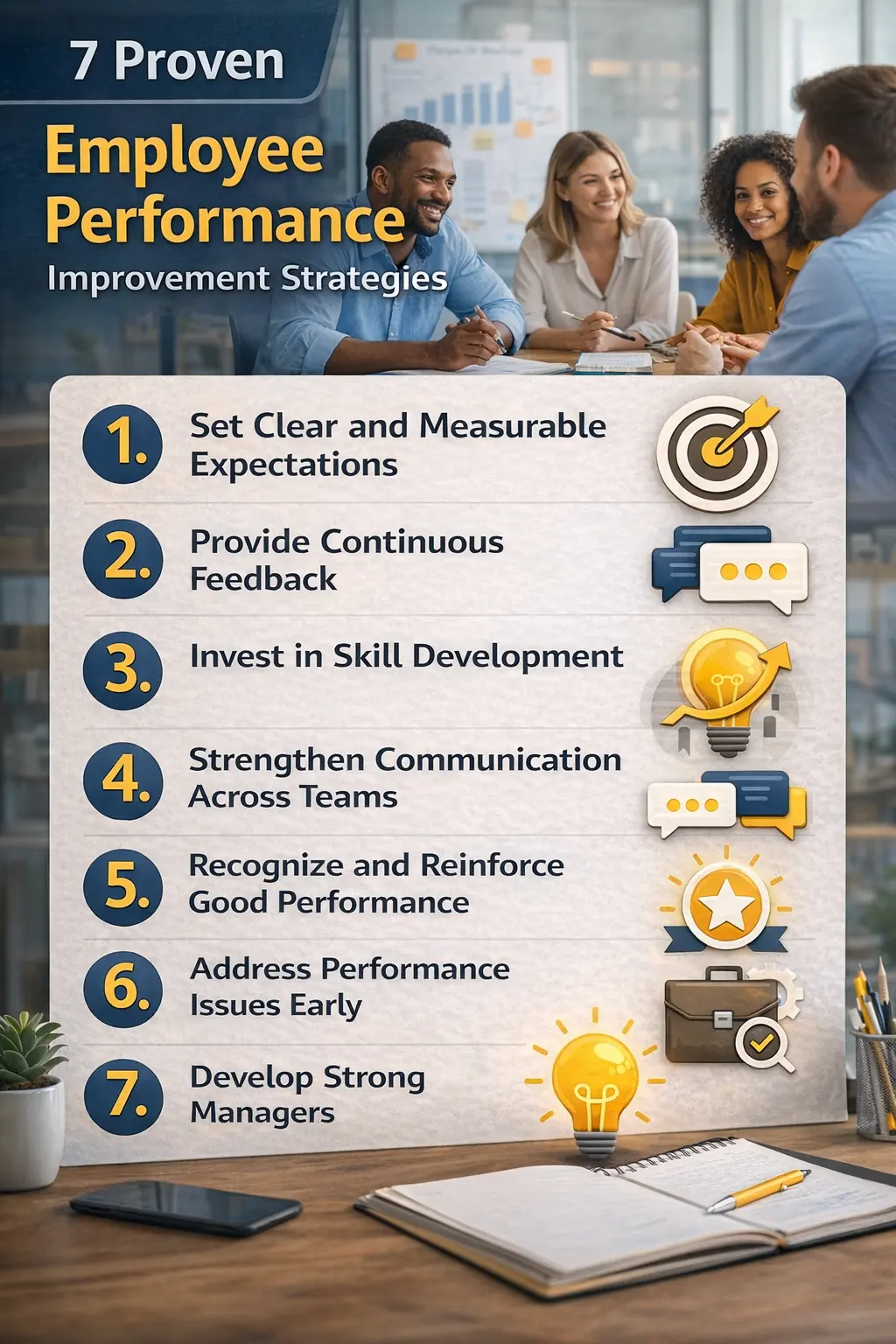
1. Set Clear and Measurable Expectations
One of the most common reasons performance declines is unclear direction. When employees are unsure about priorities, deadlines, or quality standards, productivity suffers. Clear, measurable goals remove confusion and improve accountability.
Define what success looks like in specific terms. Establish timelines and performance benchmarks. When expectations are documented and discussed regularly, employees feel more confident and focused. Clarity reduces stress and increases output without adding pressure.
2. Provide Continuous Feedback
Annual performance reviews are no longer enough. Employees need timely, constructive feedback to adjust their performance in real time. Regular one-on-one conversations allow managers to address small issues before they become larger problems.
Effective feedback should be specific, balanced, and solution-oriented. Instead of general comments, focus on behaviors and outcomes. Consistent communication builds trust and improves employee performance steadily over time.
3. Invest in Skill Development
Sometimes underperformance is not about effort but capability. Roles evolve quickly, and employees need updated skills to keep pace. Providing access to training, mentorship, and learning opportunities equips your team to perform at higher levels.
According to workplace learning research from LinkedIn, organizations that prioritize employee development experience higher engagement and retention rates. When employees see growth opportunities, they become more motivated and committed to delivering strong results.
4. Strengthen Communication Across Teams
Miscommunication often leads to missed deadlines, duplicated work, and frustration. Clear communication improves coordination and execution. Encourage structured meetings, written follow-ups, and clearly assigned responsibilities.
Employees perform better when they understand how their work connects to others. Transparent communication also builds psychological safety, which encourages collaboration and initiative. Improving communication systems is one of the fastest ways to improve employee performance.
5. Recognize and Reinforce Good Performance
Recognition is a powerful driver of motivation. When employees feel that their efforts are seen and valued, they are more likely to maintain high standards. Recognition does not always need to be financial. Public acknowledgment, growth opportunities, and additional responsibilities can be equally effective.
Consistent recognition reinforces positive behaviors and strengthens workplace culture. A simple acknowledgment at the right time can significantly boost morale and productivity.
6. Address Performance Issues Early
Avoiding difficult conversations often leads to bigger performance challenges later. When issues are identified early, they can be resolved constructively. Approach conversations with curiosity rather than blame.
Discuss expectations clearly, listen to employee concerns, and create a short-term improvement plan. Early intervention protects team morale and maintains overall productivity. Proactive leadership prevents performance gaps from widening.
7. Develop Strong Managers
Managers have a direct impact on employee performance. Employees look to leaders for clarity, direction, and support. Poor management often results in disengagement and inconsistency.
Strong managers coach, delegate effectively, and hold teams accountable while maintaining trust. Investing in leadership development ensures that performance systems function effectively. When managers improve, team performance improves.
Measuring Employee Performance the Right Way
If you want to improve employee performance, you must measure outcomes that truly reflect impact. Tracking activity alone—such as hours worked or tasks completed—does not always indicate effectiveness. Instead, focus on results that connect to business objectives.
Here are essential performance categories to consider:
| Category | What to Measure |
|---|---|
| Productivity | Output per employee, project completion rate |
| Quality | Error rates, customer satisfaction scores |
| Engagement | Survey results, participation levels |
| Efficiency | Turnaround time, workflow cycle time |
| Retention | Turnover rate, internal promotions |
Choose metrics that align with your business model and strategic priorities. When employees clearly understand how performance is evaluated, they can direct their efforts toward meaningful results. Measurement should guide improvement, not create unnecessary pressure.
Common Barriers to Improving Employee Performance
Understanding obstacles helps you remove them faster.
Lack of clarity
Employees don’t understand expectations.
Poor management
Leaders lack coaching skills.
Limited feedback
Employees don’t know how they’re doing.
Low engagement
Work feels disconnected from purpose.
Skill gaps
Training hasn’t kept pace with role evolution.
When you diagnose correctly, solutions become clear.
A Simple 5-Step Action Plan You Can Implement This Month
If you want immediate traction, follow this checklist:
- Clarify team goals for the quarter.
- Schedule recurring performance check-ins.
- Identify skill gaps and assign development plans.
- Launch a recognition initiative.
- Review key performance metrics weekly.
Consistency beats intensity.
Frequently Asked Questions
What are the main causes of poor employee performance?
Poor performance often results from unclear expectations, limited feedback, skill gaps, weak leadership, or low engagement. In many cases, employees lack direction rather than motivation. Identifying the root cause allows organizations to apply targeted and effective improvement strategies.
What is the connection between employee engagement and performance?
Employee engagement directly influences productivity and work quality. Engaged employees show stronger commitment, collaboration, and initiative. When individuals feel valued and connected to company goals, their performance naturally improves, leading to better organizational outcomes.
How can you improve employee performance quickly?
Start by clarifying expectations and increasing communication. Often, performance improves when employees understand goals clearly and receive consistent feedback. Small adjustments in direction can create noticeable improvements within weeks.
What are the most effective employee performance improvement strategies?
Clear goal setting, ongoing coaching, skill development, recognition, and strong leadership are the most effective strategies. Sustainable improvement comes from structured systems rather than one-time initiatives.
How often should performance discussions happen?
Monthly or quarterly check-ins are more effective than annual reviews. Frequent conversations maintain alignment and allow employees to adjust their performance proactively.
How do managers motivate underperforming employees?
Begin with a private conversation. Identify root causes, whether skill gaps, workload issues, or engagement challenges. Set a short-term improvement plan with measurable milestones. Motivation increases when employees feel supported, not criticized.
Conclusion
Improving employee performance at work requires structure, communication, and leadership consistency. When expectations are clear, skills are developed, and feedback is ongoing, employees perform with greater confidence and accountability.
The most successful organizations treat employee performance improvement as a continuous system rather than a short-term fix. By strengthening leadership, clarifying goals, and reinforcing positive behaviors, you create a culture where performance becomes the standard, not the exception.
Build Performance That Lasts
Improving employee performance at work is not about pressure or short-term fixes. It is about creating the right environment—where expectations are clear, feedback is consistent, leadership is strong, and growth opportunities are ongoing.
When you invest in structured performance systems, leadership development, and continuous coaching, you build more than productivity. You build accountability, engagement, and long-term business stability.
If you are ready to strengthen performance across your organization, start by evaluating how your current systems support clarity, development, and measurable results. The right strategy today can create sustainable impact for years to come.
Let’s move from reactive performance management to a culture where excellence becomes the standard.