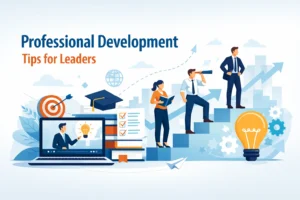

Leadership today looks very different than it did even a decade ago. Rapid technological change, evolving employee expectations, hybrid work environments, and constant market disruption have raised the bar for what it means to be an effective leader. Technical expertise and years of experience alone are no longer enough.
What separates strong leaders from truly impactful ones is a commitment to continuous growth.
Professional development is no longer a one-time milestone or a box to check. It’s an ongoing process that helps leaders stay adaptable, confident, and relevant in an ever-changing workplace. Leaders who actively invest in their development don’t just improve their own performance — they elevate their teams, strengthen organizational culture, and drive long-term success.
In this guide, we’ll explore essential professional development tips for leaders who want to grow intentionally, lead effectively, and remain future-ready.
Why Professional Development Matters for Leaders?
Professional development isn’t just about acquiring new skills. It’s about refining judgment, expanding perspective, and learning how to lead people through uncertainty and change.
According to a LinkedIn Workplace Learning report, employees are significantly more likely to stay with organizations that invest in learning and development. Leadership development, in particular, has a direct impact on engagement, retention, and performance. According to the LinkedIn Workplace Learning Report, 94% of employees say they would stay longer at a company that actively invests in learning and development.
For leaders, professional development:
- Improves decision-making and problem-solving
- Strengthens communication and emotional intelligence
- Builds confidence during change or crisis
- Enhances credibility and influence
- Supports long-term career growth
Simply put, leaders who stop learning eventually stop leading effectively.
10 Tips for Professional Development Every Leader Should Know
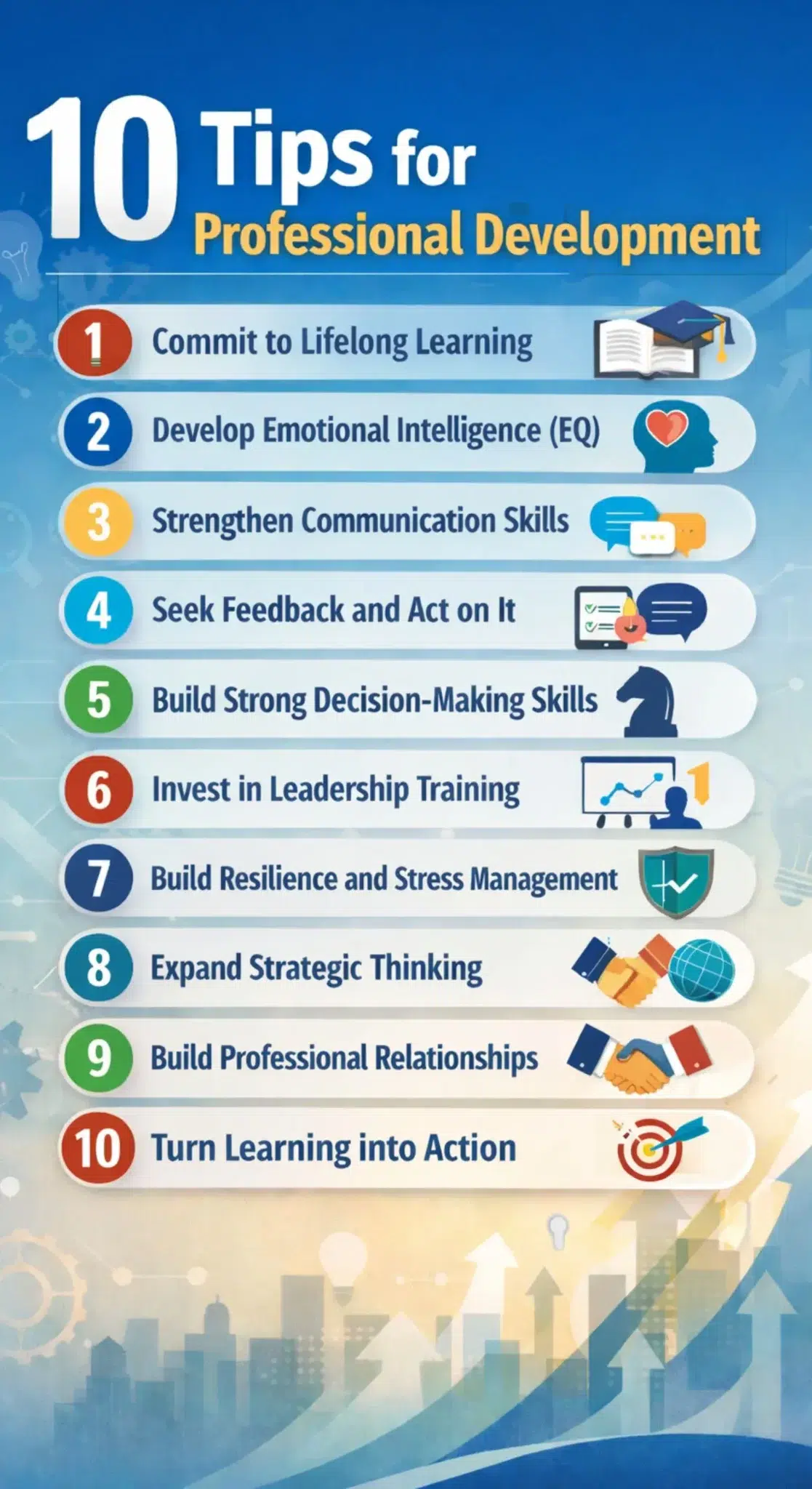
1. Commit to Lifelong Learning
One of the most important tips for professional development is adopting a mindset of continuous learning. The most effective leaders recognize that growth doesn’t stop after a promotion or a title change. The World Economic Forum estimates that 50% of all employees will need reskilling due to rapidly changing job requirements, making continuous learning a leadership necessity rather than a choice.
This doesn’t mean returning to school full-time — it means staying curious and intentional about learning. Leaders can expand their knowledge through:
- Leadership workshops and training programs
- Industry conferences and webinars
- Professional certifications
- Thought leadership articles and books
- Peer learning and discussion groups
The goal is not to know everything, but to remain adaptable as new challenges emerge.
2. Develop Emotional Intelligence (EQ)
Emotional intelligence is one of the most critical leadership skills today. Leaders with strong EQ understand their own emotions, recognize emotional cues in others, and respond thoughtfully rather than reactively.
Research published by Harvard Business Review consistently highlights emotional intelligence as a key predictor of leadership effectiveness. Leaders with high EQ tend to build stronger relationships, manage conflict more effectively, and foster trust within teams.
Practical ways to build EQ include:
- Practicing active listening
- Asking for feedback and reflecting on it
- Developing empathy through perspective-taking
- Managing stress and emotional responses during pressure
Strong emotional intelligence directly supports better leadership presence and influence.
3. Strengthen Communication Skills
Clear, consistent communication is a cornerstone of effective leadership. Leaders who communicate well create alignment, reduce uncertainty, and build trust. Gallup research shows that managers account for up to 70% of the variance in employee engagement, underscoring how critical leadership communication truly is.
Professional development tips related to communication often focus on:
- Delivering clear expectations
- Providing constructive feedback
- Leading difficult conversations
- Communicating during change or crisis
- Adapting communication styles to different audiences
According to Gallup, teams with clear communication experience higher engagement and fewer misunderstandings. For leaders, investing in communication skills courses pays dividends across every aspect of the organization.
4. Seek Feedback and Act on It
Great leaders don’t avoid feedback — they actively seek it. Feedback provides insight into blind spots, leadership impact, and opportunities for growth that self-reflection alone can’t reveal.
Effective professional development includes:
- Asking for feedback from peers, direct reports, and supervisors
- Using 360-degree feedback tools when available
- Reflecting on recurring themes rather than isolated comments
- Taking visible action on feedback received
Leaders who act on feedback demonstrate humility and commitment to growth, which strengthens trust and credibility across teams.
5. Build Strong Decision-Making Skills
Leadership often requires making decisions with incomplete information, tight timelines, and competing priorities. Professional development helps leaders sharpen judgment and reduce decision fatigue.
Key development areas include:
- Critical thinking and analysis
- Risk assessment and mitigation
- Data-informed decision-making
- Balancing speed with accuracy
- Learning from past decisions
According to McKinsey research, organizations with strong decision-making practices outperform peers on both financial and operational outcomes. Leaders play a central role in building that capability.
6. Invest in Leadership Training and Development Programs
Structured leadership development training programs offer focused learning, expert guidance, and practical application. These programs help leaders strengthen skills that are difficult to develop through experience alone.
High-impact leadership training often covers:
- Leadership communication and influence
- Conflict management and workplace civility
- Change management and resilience
- Team performance and engagement
- Ethical decision-making
Formal development programs also provide leaders with time and space to reflect, practice, and apply new skills in real-world scenarios.
7. Build Resilience and Stress Management Skills
Leadership can be demanding, and burnout is a growing concern across industries. Professional development should include strategies for managing stress and maintaining personal resilience.
Resilient leaders:
- Stay composed during uncertainty
- Recover more quickly from setbacks
- Model healthy behaviors for their teams
- Make clearer decisions under pressure
The World Health Organization has identified workplace stress as a major productivity challenge. Leaders who invest in resilience training help protect both their well-being and their team’s performance.
8. Expand Strategic Thinking Capabilities
Effective leaders look beyond daily tasks and focus on long-term impact. Strategic thinking helps leaders align actions with organizational goals and anticipate future challenges.
Professional development tips in this area include:
- Understanding broader business and industry trends
- Connecting team objectives to organizational strategy
- Evaluating long-term risks and opportunities
- Thinking systemically rather than reactively
Strategic leaders create clarity and direction, especially during periods of change.
9. Build Strong Professional Relationships and Networks
Leadership is not a solo effort. Strong professional relationships support learning, collaboration, and career growth.
Developing a strong network allows leaders to:
- Learn from peers facing similar challenges
- Gain diverse perspectives
- Access mentorship and guidance
- Stay informed about industry best practices
Networking is not about self-promotion — it’s about shared learning and mutual support.
10. Turn Learning into Action
Professional development is only effective when learning translates into behavior change. Leaders should focus on applying new insights immediately rather than waiting for “the perfect time.”
Effective application strategies include:
- Setting specific development goals
- Practicing new skills in real situations
- Reflecting on what worked and what didn’t
- Adjusting approaches based on outcomes
Consistent action transforms knowledge into leadership capability.
Common Mistakes Leaders Make in Professional Development
Even well-intentioned leaders can undermine their growth by:
- Treating development as optional rather than essential
- Focusing only on technical skills
- Ignoring feedback
- Avoiding discomfort or challenge
- Neglecting self-care
Recognizing and correcting these patterns is itself a powerful step in leadership development.
The Long-Term Impact of Professional Development
Leaders who prioritize professional development see measurable results. Research from Deloitte reinforces this impact, finding that organizations that invest in leadership development are 2.4 times more likely to hit their performance targets.
- Build stronger, more engaged teams
- Adapt faster to change
- Improve organizational culture
- Reduce turnover and burnout
- Increase long-term effectiveness
According to Deloitte, organizations with strong leadership development programs are better positioned to navigate disruption and sustain performance over time.
Professional development isn’t just an individual investment — it’s a strategic advantage.
Conclusion
Leadership excellence doesn’t happen by accident. It’s built through consistent learning, reflection, and growth.
These professional development tips serve as a roadmap for leaders who want to remain effective, adaptable, and confident in today’s complex work environment. By investing in personal growth, leaders don’t just improve themselves — they create stronger teams, healthier workplaces, and more resilient organizations.
In a world where change is constant, professional development is no longer optional. It’s essential.
Take the Next Step in Your Leadership Development
Reading about professional development is the first step — applying it is where real leadership growth begins.
If you’re ready to strengthen your leadership skills, improve decision-making, and lead with confidence in today’s complex work environment, structured training can make the difference. Leadership and professional development courses help leaders build practical skills in communication, decision-making, resilience, and strategic thinking.
Contact PTR Training to learn more about leadership & professional development courses and start building the skills today’s leaders need for tomorrow’s challenges.
Frequently Asked Questions
1. How often should leaders focus on professional development?
Professional development should be ongoing, not occasional. Leaders benefit most when they set aside time quarterly or annually to assess skills, seek feedback, and pursue targeted learning aligned with their evolving responsibilities.
2. What types of professional development are most effective for leaders?
The most effective professional development combines formal learning (training programs, workshops), experiential learning (on-the-job challenges), and reflective practices such as coaching, mentoring, and feedback-based development.
3. Can professional development improve leadership effectiveness without changing roles?
Yes. Leaders don’t need a new role or promotion to grow. Professional development enhances decision-making, communication, resilience, and strategic thinking—skills that directly improve effectiveness in any leadership position.
4. How does professional development support leaders in managing change?
Professional development equips leaders with tools for adaptability, strategic thinking, and emotional intelligence. These skills help leaders navigate uncertainty, communicate change clearly, and maintain team engagement during transitions.
5. What role does leadership training play in long-term career growth?
Leadership training accelerates career growth by strengthening core competencies such as influence, problem-solving, and people management. It also prepares leaders for future roles by expanding perspective and strategic capability.